
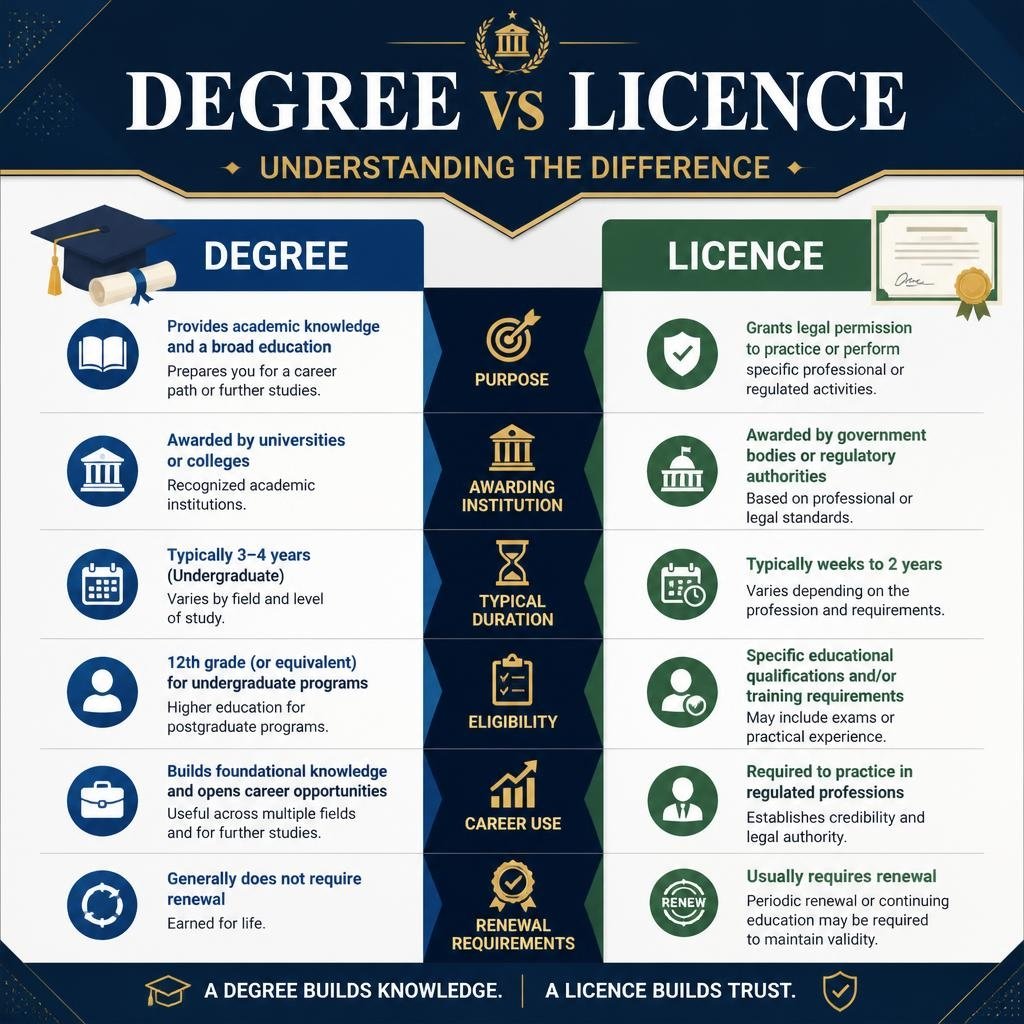
You finished the degree. Why can’t you work yet?
Imagine a student who has just finished six hard years in a medical school, or five years of pharmacy, or four to five years of nursing science. The result is out, the convocation photographs are done, and the family has celebrated. Then comes a sentence nobody emphasised in first year: your certificate is not your licence.
For a large group of Nigerian courses, graduating is only the end of the academic stage. The law, enforced by a professional council, says you cannot call yourself a doctor, lawyer, pharmacist, nurse or engineer, or do the work that belongs to that title, until you complete a second stage. That second stage may be a supervised year in a hospital, a year at the Nigerian Law School, a professional qualifying examination, a period of experience, or all of these together.
This guide explains exactly what that means in practice. You will learn which degrees work this way, what each stage involves, what happens if you delay, fail, or skip a stage, how the system is under strain right now, and how to plan so that a licence gap does not quietly cost you one or two years.
The short answer: if your degree requires professional registration, then until you are registered, you are a graduate but not yet a practitioner. You may be allowed to work in a limited, supervised role (for example, a house officer or an intern pharmacist), or you may not be allowed to work in the profession at all. In either case, you cannot practise independently, you cannot lawfully use the professional title, and employers, foreign regulators and NYSC will treat you as incomplete until the council says otherwise.
What this guide covers
We first explain the basic difference between a degree and a licence. Then we walk through the pathway in medicine and dentistry, law, pharmacy, nursing, engineering and accountancy, with the real numbers and rules the regulators have published. After that, we cover what happens when things go wrong, what is different for foreign-trained graduates, how to verify that your programme is accredited before you commit, and a practical plan you can follow from admission to your first annual licence.
Degree versus licence: the distinction that decides everything
A university awards a degree. A university is accredited to teach, examine and certify that you completed a programme of study. In Nigeria, the National Universities Commission (NUC) is the body that approves and accredits university programmes.
A professional council awards the right to practise. A council is a statutory body, created by an Act of the National Assembly, that decides who may enter a profession, keeps the official register of practitioners, sets the code of conduct, disciplines members, and can remove a name from the register. Examples include the Medical and Dental Council of Nigeria (MDCN), the Nursing and Midwifery Council of Nigeria (NMCN), the Pharmacy Council of Nigeria (PCN), the Council for the Regulation of Engineering in Nigeria (COREN), and, for law, the Council of Legal Education with the Nigerian Law School and the Body of Benchers.
These are two separate systems with two separate sets of rules. They overlap, but neither automatically satisfies the other. That is why a graduate can hold a perfectly genuine first-class degree and still be unable to practise: the university did its job, but the council has not yet completed its own.
Why regulation exists
It helps to understand the reason, because it explains why the process feels demanding. These professions deal with human life, public money, public safety, or the rights of people before the law. A wrongly dispensed drug, a badly designed building, a mismanaged delivery or an incompetent court filing can cause serious, sometimes irreversible, harm. So the state requires proof of competence that goes beyond classroom results: supervised practice, an independent examination, a character check, and ongoing membership discipline.
In other words, a council is not trying to punish graduates. It is trying to confirm that someone who learned a subject can safely do the work.
The vocabulary you will meet
The councils use different words for similar ideas. Here are the main ones in plain language.
- Induction or oath-taking: a ceremony where graduates formally take the professional oath, usually organised with the council. In several professions, induction is the moment you receive your first registration document.
- Provisional registration: a temporary, limited entry on the register that lets you undergo supervised training. It is not full permission to practise.
- Indexing: the process, mostly in nursing, of presenting students to the council while still in training so that they are officially recognised and can sit the council’s examination.
- Housemanship / internship: a compulsory, supervised period of practical training after graduation. Doctors call theirs housemanship; pharmacists call theirs internship.
- Professional qualifying examination: an examination set by the council, not the university.
- Full registration: your name is on the full register; you may practise independently, subject to licensing.
- Annual practising licence: the yearly renewal that proves you are still in good standing.
- Accreditation: official approval of a programme, by the NUC and, for many courses, also by the relevant professional council.
Keep these terms in mind. They appear again and again below.
The typical journey from graduation to practice
The details differ between professions, but most regulated pathways follow the same broad sequence.
- Graduate from an accredited programme. The programme must be approved. If it is not, everything after this is at risk.
- Present yourself to the council. This might be through your department, through the school’s list of graduands, or through an induction ceremony.
- Get a provisional or entry registration (where the profession uses one).
- Complete the compulsory supervised stage. Housemanship, internship, Law School, or a required period of experience.
- Pass the professional examination where one is required.
- Apply for full registration or enrolment, and receive your registration number.
- Renew your licence every year and keep up continuing professional development (CPD).
- Complete NYSC when you are eligible. In some professions the council’s registration is a condition for NYSC mobilisation, which we discuss later.
The table below compares the main professions at a glance. It summarises rules published by each regulator; always check the council’s own notice for the current version.
| Degree | Regulator | What you must do after the degree | What the registration gives you |
|---|---|---|---|
| Medicine (MBBS/MBChB) and Dentistry | MDCN | Induction, provisional registration, 12 months of housemanship in an accredited centre | Full registration, then annual licence |
| Law (LL.B) | Council of Legal Education / Nigerian Law School / Body of Benchers | Nigerian Law School, Bar Final Examination, Call to Bar, enrolment at the Supreme Court | Right to practise as a Barrister and Solicitor, subject to annual practising fee |
| Pharmacy (B.Pharm) | PCN | Oath and provisional registration, 12-month internship under a registered pharmacist, then full registration | Registration as a pharmacist, then annual licence |
| Nursing (BNSc) | NMCN | Indexing, the council’s Final Professional Qualifying Examination, then registration and licensing | Registered Nurse status and practising licence |
| Engineering (B.Eng) | COREN | Graduate of a COREN-accredited programme, post-graduation experience, professional interview or examination, then registration | Right to be registered and licensed as an engineer |
| Accounting (B.Sc Accounting) | ICAN or ANAN | Professional examinations (with exemptions for accredited degrees), practical experience, membership | Chartered or certified accountant status; separate practising licence for public practice |
Medicine and dentistry: the most structured pathway
Medicine is the clearest example of how a degree and a licence are separated.
Stage 1: The degree and induction
Medical education in Nigeria is generally six years. When you graduate from an MDCN-accredited school, you are inducted and take the professional pledge. At induction, the MDCN issues a provisional registration certificate. The Council has described this certificate as the document that allows a new doctor to apply for housemanship.
Stage 2: Provisional registration
Provisional registration exists for one purpose: to let a young doctor train under supervision in an approved hospital. The MDCN’s own press release on professional ethics for house officers says this plainly, and it adds a crucial warning: provisional registration does not guarantee automatic entry to the full register. Full registration is granted only after satisfactory completion of housemanship.
That sentence is easy to read past, so read it again. A provisionally registered doctor is practising under supervision, as a trainee. He or she is not a fully registered doctor.
The Council also says the provisional certificate is valid for 24 months, within which the doctor is expected to have started housemanship. A January 2026 notice from the Council tells newly inducted doctors to create a profile on the MDCN housemanship portal as soon as they have their provisional certificate. The posting process runs through a centralised system, and the Council’s standard operating procedure explains that you register on the portal using the information on your provisional certificate, then look at the institutions with vacancies and select your preference.
Stage 3: Housemanship
The MDCN’s registration guidelines require newly qualified doctors and dentists to complete twelve months of uninterrupted housemanship in an MDCN-accredited centre before they become eligible for full registration. In April 2026, the Council’s registrar, speaking through a representative at an induction ceremony in Abia State, described the training as twelve months covering the main areas of Medicine, Surgery, Obstetrics and Gynaecology, and Paediatrics, and said it is required both for full registration and for eligibility to be mobilised for the National Youth Service.
Two details from that same report matter a great deal for planning.
First, the Council said housemanship should be completed within two years of registration. A doctor who fails to meet that timeline, or whose provisional licence expires, must demonstrate continued competence or sit and pass an assessment examination before moving on. In other words, drifting is not a neutral choice. It can add a new examination to your path.
Second, the Council warned graduates to secure a placement immediately after they receive the provisional certificate, rather than waiting.
Stage 4: The placement bottleneck
In February 2026, the MDCN registrar told the Senate Committee on Health during the 2026 budget defence that roughly 6,000 doctors graduate from Nigerian medical schools each year, while the centralised housemanship system can accommodate about 4,000. She explained that about 2,000 doctors therefore face difficulty in securing a place each year, and she argued that bringing state-owned and private hospitals into the centralised system would help.
What does that mean for a student? It means the legal requirement and the practical capacity do not perfectly match. A doctor can meet every academic requirement and still wait for a placement. During that wait, they are neither fully registered nor earning a normal doctor’s income. Some graduates fill the gap with supervised roles, research assistance or non-clinical work, but they cannot lawfully act as independent doctors.
This is the single biggest practical risk in medicine: not failing an exam, but time lost between degree and placement. That is why the Council keeps urging graduates to apply on the portal early and to use only the official placement route.
Stage 5: Full registration and the annual licence
After satisfactory housemanship, the doctor applies for full registration. A good general summary of the documents involved includes the degree certificate, the O-level result, a birth certificate, the provisional registration certificate and the completed housemanship assessment forms. Treat the list as a guide and confirm the current checklist on the MDCN portal. Once fully registered, the doctor needs an annual licence to continue to practise.
What the MDCN warns house officers about
The Council has also issued guidance about the conduct of house officers. In 2024, its registrar warned that taking part in certain association activities during housemanship could jeopardise a house officer’s progress to full registration. The point is not to discuss union politics, but to show how closely the Council watches the conduct of trainees. House officers are expected to read and follow the Council’s guidelines throughout the year, because the final assessment depends on it.
Dentistry
Dentistry follows the same two-stage model through the MDCN: provisional registration, housemanship in an approved centre, then full registration. The MDCN’s online registration menu lists medical and dental registration side by side, including provisional registration, full registration, annual licence and certificate of good standing.
Foreign-trained graduates in medicine
Graduates of foreign medical schools face a different entry route. The MDCN conducts an assessment examination for foreign-trained medical and dental graduates. It released results for its June 2026 sitting and publishes an induction notice for those who pass. Candidates who pass are inducted and then move into the provisional registration and housemanship pathway. A foreign degree therefore does not exempt anyone from the Nigerian requirements.
Law: the degree does not make you a lawyer
Law is unique because the second stage is not a hospital-style year of supervised work, but a full professional course.
Step 1: The LL.B from an approved programme
In Nigeria, you first study for a Bachelor of Laws. The Council of Legal Education has warned that students who enrol in law programmes that are not approved will be barred from entering the Nigerian Law School. That is an important reminder to verify the programme’s approval status, with both the NUC and the Council of Legal Education, before you pay a single naira in school fees.
Step 2: The Nigerian Law School
After the LL.B, you apply to the Nigerian Law School, run by the Council of Legal Education, headquartered in Bwari, Abuja, with other campuses across the country. The Law School programme prepares you for the Bar Final Examination.
Be aware that there is a backlog problem. The Law School’s Director-General has publicly said that excess admissions into law faculties have contributed to a backlog of law graduates waiting for places in the Law School. If you finish an LL.B, you may not be able to start Law School immediately.
Step 3: The Bar Final Examination
The Bar Final Examination is the qualifying examination for the Call to Bar. The numbers show how real the risk is. In the December 2025 sitting, about 7,600 candidates took the examination, and more than 1,000 failed, according to a news report on the results. A later resit in May 2026 produced further failures: a Legit.ng report put the number of candidates who failed that resit at 983.
The Law School’s Director-General has also floated, publicly, the possibility of limiting the number of attempts candidates can make at the Bar Final. That is not a rule yet, but it signals the direction of the debate and is a reason to take the first attempt seriously.
For the current academic session, a secondary source reports that the Bar Final examinations are scheduled from 31 October to 7 November 2026. Results and the Call to Bar date are announced by the Council nearer the time. Treat dates from secondary sources as provisional and confirm them on the Law School’s website.
Step 4: Screening and the Call to Bar
Successful candidates go through screening and then the Call to Bar ceremony. In 2026, a total of 6,009 candidates were called to the Bar at ceremonies held in Abuja from 7 to 10 July. Reports of earlier screenings show that candidates are asked for documents such as the Bar Final result printout, the original LL.B certificate with its security seal, an alumni form and the Law School identity card. Check the current notice, because the list is published for each cycle.
The Body of Benchers, which conducts the Call to Bar, also admits candidates after it is satisfied about their fitness in learning and character. So the process is not purely academic. Character matters.
Step 5: Enrolment at the Supreme Court and the annual practising fee
Being called to the Bar is not the last step. A person who has been called must be enrolled at the Supreme Court, which keeps the roll of legal practitioners. Under the Legal Practitioners Act, entitlement to practise is tied to being called and enrolled. Lawyers also pay an annual practising fee; a Federal High Court judgment reported in the legal press has said that a lawyer who is called, enrolled and has paid the annual practising fee is legally entitled to practise.
What this means in practice
Until you are called to the Bar and enrolled, you may be a law graduate, but you cannot appear in court as a lawyer or sign legal documents as one. Even after the Call to Bar, the Body of Benchers has publicly cautioned people about misuse of the title “Barrister”, which shows the title itself is regulated. Law graduates who have not completed the process should describe themselves accurately, for example as “LL.B graduate”.
