By the Toolfol Editorial Team | Category: Careers & Opportunities | Information reviewed 28 November 2026
You have a first degree or HND, a job (or a search for one), and a nagging question: should you go back to school for a Master’s degree, or should you spend that money and energy on a professional certification such as ICAN, CIPM, PMP, ACCA or a cloud-computing credential? Friends will tell you different things. Your boss may say “get your Master’s.” A recruiter may say “nobody cares about Master’s, get certified.” A relative abroad may say “just japa and study there.”
The honest answer is that neither option is automatically better. The right choice depends on your profession, your career goal, your money, your time, and what the people who will hire or promote you actually require. This guide gives you a practical way to decide whether a postgraduate degree or professional certification in Nigeria is the better next step for you, with the facts we could verify, the places where rules differ, and the mistakes that cost Nigerians time and money.
Quick Answer: Which Should You Choose?
Summary box
- Choose a postgraduate degree if your target path requires one (lecturing, research, many senior public-sector and development roles, specialist clinical or technical tracks), if you want to change field in a structured way, or if you plan to study or work abroad where a Master’s is the entry ticket.
- Choose a professional certification if your profession is regulated or credential-driven (accounting, engineering, law, medicine, HR, project management, IT security, cloud), if you want a faster and cheaper credibility boost, or if employers in your field ask for named certifications in job adverts.
- Choose both, in sequence, if you aim for senior leadership in a technical or regulated field. Most people should do one first and let the career, not anxiety, decide the second.
- Choose neither yet if you have no clear target role. Spending money on a credential before you know who will value it is the most expensive mistake in this decision.
No credential guarantees a job, promotion or particular salary. What a credential can do is remove a barrier (a missing requirement), prove skill to someone who cannot see your work, or open a door that was closed. Your decision should be built around which barrier you are trying to remove.
The One Question That Decides Most Cases
Before comparing fees and syllabuses, answer this: “What specific job or position do I want in the next three to five years, and what does the advert, scheme of service or regulator say is required for it?”
That question beats general opinions for three reasons:
- Requirements are written down. Job adverts, universities’ staff recruitment notices, professional bodies and public-service schemes state minimum qualifications. Reading ten real adverts for your target role teaches you more than a hundred opinions.
- Credentials are only valuable to the people who recognise them. A certification famous in banking may mean little in a university department, and a PhD may add little in a sales-driven company.
- It prevents “credential collecting.” Many people stack qualifications hoping something will work. A target role tells you which one to pick first.
If you cannot yet name a target role, spend two to four weeks researching before paying for any programme. A later section gives you a step-by-step method.
What Each Option Actually Is
People use “postgraduate degree,” “certificate,” “professional qualification” and “licence” loosely. They are not the same, and mixing them up leads to expensive surprises.
Postgraduate degrees and diplomas in Nigeria
A postgraduate qualification is a programme you take after a first degree (and in some cases after an HND). The common types are:
| Qualification | Typical purpose | Typical shape |
|---|---|---|
| Postgraduate Diploma (PGD) | Bridge for people with weaker first-degree classes, HND holders, or career-changers who need grounding in a new field | Short, usually about two semesters at institutions that publish it (for example, Elizade University lists a minimum duration of two semesters) |
| Master’s (MSc, MA, MEd, MPA, LLM, etc.) | Deeper specialisation; a common requirement for academic and some senior roles | Coursework plus a dissertation or project; length differs by institution and mode |
| MBA / professional Master’s | Management and leadership, or a practice-oriented specialism | Often part-time or executive formats; entry rules may differ from research Master’s |
| MPhil | Research training, sometimes a stepping stone to a PhD | Research-heavy |
| PhD | Original research and academic or high-level research careers | Multi-year; research-focused |
Important: exact duration, structure and fees differ by university and by whether you study full-time, part-time, weekend or distance. Always confirm on the institution’s postgraduate school page.
Professional certifications
“Professional certification” is a wide umbrella. It helps to split it into three types, because they behave very differently.
1. Statutory or regulatory qualifications (you may be legally required to hold them to practise). Examples include qualifying as a chartered accountant through the Institute of Chartered Accountants of Nigeria (ICAN), registration as an engineer with the Council for the Regulation of Engineering in Nigeria (COREN), call to the Bar for lawyers, or registration for medical doctors with the Medical and Dental Council of Nigeria. In these fields, the professional route is not optional extra credit; it is the gate to the title and to certain kinds of work.
2. Professional-body memberships and qualifications (widely respected, sometimes expected, not always legally required). Examples include ICAN or ANAN for accountants, the Chartered Institute of Personnel Management (CIPM) for HR, ACCA, CFA and similar finance qualifications, or chartered institutes in marketing, banking, taxation and procurement. They usually involve exams, experience requirements, ethics rules and continuing professional development.
3. Vendor or skills certifications (prove practical skills on a specific technology or method). Examples are cloud-platform certifications, cybersecurity credentials, project-management credentials such as PMP, Scrum and agile certificates, and data and analytics certificates. These change quickly, because technologies change quickly.
A quick test: Can the profession legally stop you from practising or using a title without it? If yes, it is a regulatory qualification. If employers prefer it but no law requires it, it is a professional or skills credential.
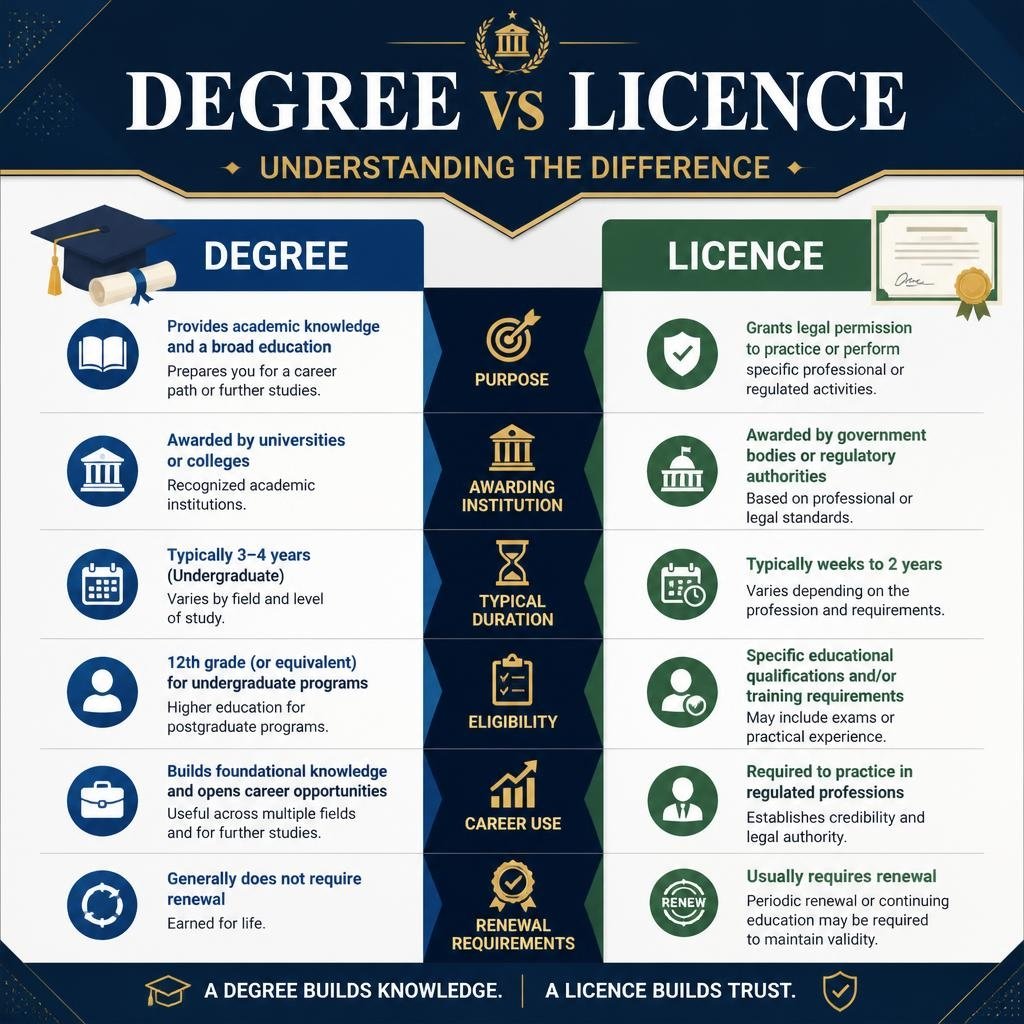
Degree, certificate, licence: why the difference matters
- A degree is awarded by a university after an academic programme approved by the university Senate and recognised under Nigerian higher-education regulation.
- A certification is awarded by a professional body or vendor after you pass an assessment and, often, meet experience and ethics requirements.
- A licence or registration is permission to practise granted by a regulator.
A Master’s degree in accounting does not make you a chartered accountant, and a chartered accountancy qualification is not a Master’s degree. Some universities and bodies grant exemptions or recognise prior learning for each other, but those arrangements are specific and change. Never assume equivalence. Ask the awarding body in writing.
How the Two Paths Differ at a Glance
| Factor | Postgraduate degree | Professional certification |
|---|---|---|
| Main value | Depth of knowledge, academic recognition, access to research and teaching careers, general credibility | Proof of job-ready or profession-specific competence; often a gate to a title or role |
| Time | Usually one to several years depending on level and mode | From weeks (some vendor certificates) to several years (full professional qualifications) |
| Cost structure | Tuition, acceptance and registration charges, project costs, possible relocation or lost income | Registration, exam, training or materials fees, annual dues, renewal or CPD costs; some fees may be in foreign currency |
| Recognition | Broad; recognised across sectors and often abroad if the institution is recognised | Strong inside the relevant profession or industry; may be weak outside it |
| Shelf life | Long-lasting | Some expire or need renewal; skills credentials can age quickly |
| Flexibility | Can open academic, research and policy doors; helpful for career change | Targeted; best when you already know your field |
| Risk | Long time away from earning or overload while working; programme disruptions at some public institutions | Paying for a credential employers in your niche do not value; exam failure and re-sit costs |
This table is a summary of general patterns, not a ranking. Treat each cell as something to verify for your specific field.
What Nigerian Employers and Regulators Actually Look For
Nobody can honestly tell you “Nigerian employers prefer X.” The market is too varied. What we can say is how different parts of the job market tend to use credentials, and how to check each one yourself.
Public service and public institutions
Federal, state and institutional schemes of service often tie promotion or entry level to academic and professional qualifications. In many public bodies, a higher qualification can affect grade level or eligibility for a particular cadre, but the rules depend on the scheme of service, the agency, and sometimes whether the qualification is relevant to your duties. If you work in the public sector, ask your HR or establishment office for the applicable scheme of service and the rules on recognising new qualifications before paying for a programme.
Universities, polytechnics and colleges of education
Academic careers are where postgraduate degrees matter most. Teaching and research roles in universities typically expect advanced degrees, and progression often depends on research output and higher qualifications. A professional certification can help in applied departments but rarely replaces the research route. If lecturing is your goal, a Master’s (and eventually a PhD) is generally the central path.
Banks, fintechs and the corporate sector
In finance and corporate roles, employers often care about a mix of degree class, relevant experience, professional membership and demonstrated skills. Roles in audit, tax, risk, compliance and treasury commonly value professional accountancy or finance qualifications. Management roles may value an MBA. Because the mix differs by firm, the best evidence is the job adverts and the profiles of people already in the roles you want.
Technology, data and cyber
Tech employers frequently weigh portfolios, practical tests and experience heavily. Certifications can help prove baseline skills, particularly for cloud, security and project delivery, and are sometimes named in adverts. A Master’s can help for research-heavy roles (machine learning research, for instance) and for people who want to work or study abroad.
NGOs, development agencies and international organisations
Many development and international roles list a Master’s as a standard requirement, often alongside several years of experience. Project-management and monitoring-and-evaluation certifications also appear in adverts. Read each advert carefully, because requirements are explicit.
Regulated professions
In medicine, law, engineering, architecture, pharmacy, nursing and similar fields, the regulator’s rules come first. A Master’s may deepen expertise or support specialisation, but it does not replace the professional route. Always begin with the regulator’s current requirements.
Practical rule: Employers rarely hire a credential; they hire a person who can solve a problem. Credentials reduce the employer’s risk of choosing you. The more your field relies on trust and standards (audit, engineering, health), the more the credential matters.
Understanding Postgraduate Admission in Nigeria
If the postgraduate route interests you, check the entry rules early, because they are the most common place where people lose a year.
Typical requirements
Requirements are set by each university’s postgraduate school (and, for some programmes, by faculties and accrediting bodies). Published pages from Nigerian universities show a pattern, but not a universal rule:
- Master’s: Many institutions ask for a first degree in a relevant field with at least a Second Class Lower Division (2:2). For example, the University of Ilorin’s postgraduate admission page states a first degree not lower than 2:2 for Master’s programmes, and the National Open University of Nigeria describes a minimum of second class lower for Master’s. Some institutions ask for a Second Class Upper or higher for certain programmes, or add CGPA thresholds. The University of Nigeria, Nsukka has used wording such as at least a second class honours with a CGPA threshold for some Master’s entry routes.
- Postgraduate Diploma (PGD): Several institutions accept candidates with a third class degree or an HND at upper or lower credit, and some programmes accept professional qualifications such as ICAN or ANAN. For example, Afe Babalola University’s published criteria mention third class degrees or HND for PGD, and another Nigerian university lists relevant professional qualifications among acceptable entry qualifications.
- Master’s after HND: An HND alone generally does not qualify directly for a Master’s in many institutions; the common route is HND plus a PGD at a required grade (often credit level), and then Master’s. Rules differ, so check.
- PhD: Typically a relevant Master’s (often with a minimum grade or a Master’s by research), though some institutions publish routes for strong candidates with a good first degree. Check each programme.
- O’level: Institutions often require the same matriculation credits (including English Language and Mathematics) expected at undergraduate level, for example five credits including English and Mathematics at some institutions.
- Other items: Transcripts, academic referees, statement of purpose or research proposal, and in some cases an entrance test or interview.
Take note: These requirements come from specific university pages and examples. They are illustrations of the pattern, not a national rule. Always confirm with the exact programme you want, for the exact session.
Degree classes and CGPA on the 5-point scale
Many Nigerian universities use a five-point scale. A commonly published guide (for example, in international credential-evaluation summaries) maps the classes roughly as follows. Your institution’s own transcript and regulations are the final authority.
| Class of degree | Typical CGPA range (5.0 scale) |
|---|---|
| First Class | 4.50 – 5.00 |
| Second Class Upper (2:1) | 3.50 – 4.49 |
| Second Class Lower (2:2) | 2.40 – 3.49 |
| Third Class | 1.50 – 2.39 |
If your class is low, you still have options. A PGD can serve as a bridge at institutions that offer it, and professional certifications do not usually depend on your degree class in the same way (though some bodies require a relevant degree or exemptions are based on it). That is one reason a professional route can be attractive to graduates with lower classes.
Check accreditation before you pay
Before paying application or acceptance fees:
- Confirm the university is recognised in Nigeria, using the National Universities Commission (NUC) lists on its official website.
- Confirm the specific programme is approved or accredited, because institutions can be approved while a given programme is not yet accredited.
- If you plan to use the degree abroad or for a regulated profession, ask the receiving body or regulator whether it accepts that institution and mode of study.
- Be careful with admission “agents,” social-media admission offers and “fast-track” Master’s promises. Use the institution’s official portal.
If you cannot verify the programme, treat the offer as unverified and keep your money.
The Real Cost of Each Path
People compare tuition to exam fees and stop there. A better comparison counts every cost, including the invisible ones.
Costs of a postgraduate degree
- Application, screening and acceptance charges
- Tuition and other school charges, which differ widely between public and private institutions and between modes of study
- Project or dissertation costs (data collection, printing, travel, software)
- Accommodation or commuting if you must attend physically
- Lost income or reduced productivity if you study full-time or the schedule clashes with work
- Delays caused by supervision backlogs, calendar disruptions or industrial action in some public institutions (this varies by institution and year)
As an example of how fees can appear on official pages, the University of Nigeria’s postgraduate advert for a past session and one university’s 2026/2027 postgraduate admissions page list application-type fees at specific amounts. We deliberately do not publish fee figures here as current facts, because they change each session. Always get the current fee schedule from the school.
Costs of a professional certification
- Registration or enrolment fee
- Exam fees per paper or per attempt (re-sits add up)
- Tuition for tutorial providers, if you use them, and study materials
- Annual subscriptions, membership dues and continuing professional development (CPD) requirements
- Renewal or re-certification costs for credentials that expire
- Foreign-currency exposure, since some international bodies charge in dollars, pounds or euros, which can make costs hard to budget when exchange rates move
The cost nobody lists: time
A part-time Master’s and a multi-level professional qualification can both stretch across years. Counting only fees hides the real burden: evenings, weekends, family time and energy. Ask yourself whether you can sustain the workload for the full duration.
A hypothetical comparison (illustration only)
This is a made-up example to show the method, not real prices or outcomes.
Chidi, a graduate in accounting, works in audit and wants to move into a senior audit role.
- Option A: Master’s degree in accounting. He imagines it costs a certain amount in fees and requires evenings and a dissertation over about two years.
- Option B: Professional accountancy qualification route. He maps the stages, exam fees, tutorial costs and the experience he must log.
Chidi researches adverts for senior audit roles and finds that most list a professional accountancy qualification as required and a Master’s as optional. The decision becomes clear because he researched requirements, not because one path is generally better. For someone aiming at lecturing in accounting, the same exercise would likely point to a Master’s.
Funding and Financial Realities
Money decides what is possible, so it deserves a careful look.
Student loans: check the current position carefully
The federal student loan scheme run by the Nigerian Education Loan Fund (NELFUND) has been described by its management in 2025 as available only to first-degree students in public tertiary institutions, with postgraduate students not eligible at that time. However, a Radio Nigeria report from April 2026 states that NELFUND announced the inclusion of postgraduate students. Because sources conflict in timing and detail, do not assume you can or cannot borrow for a Master’s. Check NELFUND’s official channels for the current eligibility rules, the type of institution covered, and the repayment terms. Beware of websites claiming to offer “postgraduate loan access” for a fee; NELFUND has warned the public about unofficial sites.
Scholarships and fellowships for Nigerians
Funded opportunities exist, but they are competitive and have fixed deadlines. As of 28 November 2026:
- Chevening Scholarships (UK): The 2027/2028 application window opened on 4 August 2026 and closed on 6 October 2026, so it has closed for this cycle. Chevening’s eligibility has included Nigerian citizenship, a first degree and work experience, and a commitment to return to Nigeria for at least two years after the award. Check the official Chevening Nigeria page for the next cycle.
- Commonwealth scholarships (UK): Some UK university pages list a Commonwealth Shared Scholarship application window for 2027/28 that opens on 10 November 2026 and closes on 8 December 2026. Candidates should confirm the exact eligibility, the correct route, and deadlines on the official Commonwealth Scholarship Commission pages and the relevant university or Federal Ministry of Education notices before applying.
- University and country-specific awards: For example, one UK university’s page lists a joint scholarship for citizens of countries including Nigeria with a deadline in 2027. Details change each year.
Because deadlines are unforgiving, begin preparing documents (transcripts, referees, statement of purpose, language test if required) many months ahead.
Employer sponsorship
Some employers fund or part-fund professional certifications, and some provide study leave or sponsorship for relevant postgraduate programmes. Ask your HR team about:
- Which programmes the organisation will fund
- Whether sponsorship requires a bond (a commitment to stay for a period after completion)
- Whether study leave is paid or unpaid
- Whether the qualification affects your grade level or role
Get any sponsorship promise in writing before you pay.
Spreading the cost
Professional qualifications are often taken paper by paper, which lets you spread cost across months or years. Master’s fees are usually paid per session or semester. Neither option removes the financial burden, but each allows different pacing. Choose the pacing you can actually sustain.
Which Path Fits Your Field? A Profession-by-Profession Guide
The patterns below describe how credentials generally work in each area. They are starting points for your own research, not rules. Where we mention a body or credential, confirm current requirements on that body’s official website.
Accounting, audit, tax and finance
This is one of the most credential-driven fields. Professional accountancy qualifications, such as those from ICAN and the Association of National Accountants of Nigeria (ANAN), or international ones such as ACCA, are the standard route to professional status. ICAN describes its pathway as an Accounting Technicians Scheme (ATS) for people entering the field and a Professional Examinations stage for those with a relevant academic background, leading to associate and then fellow membership. Some Nigerian universities even list ICAN or ANAN among acceptable entry qualifications for their postgraduate diploma programmes, which shows how the two systems can connect.
Usually better first: a professional qualification, if you want to work in audit, tax, financial reporting or practice. Master’s makes sense when: you want to lecture, move into research, shift to a different specialism (for example, from accounting into finance or economics), or need an MBA-type programme for general management.
Engineering, architecture and the built environment
Engineers in Nigeria register with COREN, and the profession has its own pathways to registration and chartered status. A Master’s in engineering can deepen technical specialism and support research or academic careers, but registration and professional recognition follow the regulator’s route, which typically involves relevant experience and assessment.
Usually first: get on the registration pathway early, because experience logged and assessments passed take time. Master’s makes sense when: you want a specialism (structural, petroleum, power, environmental), a research career, or admission abroad.
Law
Lawyers qualify through the law degree, the Nigerian Law School and call to the Bar. A Master’s in law (LLM) can support specialisation in areas such as energy, commercial, maritime or human rights law, and is often valued for academic careers or niche practice. Professional certifications in the narrow sense play a smaller role than in accounting or IT, though specialist short courses and compliance certifications exist.
Medicine, nursing, pharmacy and health professions
These fields are heavily regulated, and postgraduate training is tied to professional colleges and fellowships. For doctors, the postgraduate medical colleges run the specialist training route. Public-health Master’s degrees (for example, MPH) suit people moving into public health, programme management or research. Always follow the regulator’s and the relevant college’s guidelines for specialist routes, since they control the pathway.
Human resources and management
HR professionals often pursue membership of professional institutes such as CIPM, and managers sometimes add an MBA or a Master’s in management. A certification can validate HR practice knowledge quickly. An MBA can broaden strategic and financial skills and expand networks, which matters if you aim for general-management or executive roles.
Project management, monitoring and evaluation
Project-management credentials (such as PMP, PRINCE2 or agile credentials) and M&E certificates are named in many project-based job adverts, especially in construction, telecoms, consulting and development work. If your goal is to prove delivery skills for projects, a recognised certification plus a track record of delivered projects can be an efficient route. A Master’s in project management or development studies suits those who want a broader academic base or an international development career.
Information technology, data and cybersecurity
Cloud, security and data certifications can help you prove job-ready skills quickly, and they are often renewed periodically. Employers in this field also look at your projects, code, incident experience or portfolio. A Master’s in computer science, data science or cybersecurity helps for research, specialised engineering and study or work abroad, and can help career changers who lack a technical first degree. If your first degree is in a different field, a PGD or Master’s can provide structured foundations, while certifications and projects supply practical evidence.
Education and academia
If you want to teach in a university or advance in a college of education or polytechnic, advanced degrees are central. Teachers in primary and secondary education should also check teacher-regulation requirements, since teacher registration and professional qualifications in education are governed separately from general postgraduate study. Professional development certificates alone rarely replace the academic route in higher education.
Banking, insurance and capital markets
These sectors have professional bodies and regulatory expectations for certain roles, such as those handled by banking institutes, insurance institutes and capital-market regulators. Professional membership may be expected for particular functions. An MBA or Master’s in finance may support progression into leadership and strategy, but check your institution’s own career framework.
Entrepreneurs and freelancers
If you run your own business or freelance, customers rarely ask for your Master’s. They ask whether you can deliver. A targeted certification may help win trust in a niche (for example, a recognised analytics or design certification), but your portfolio, referrals and results matter more. Unless a Master’s directly supports your market (for instance, consultancy where clients value academic credentials), spend carefully.
Summary table: where each path tends to lead
| Your goal | Often the stronger first step | Why | Check before paying |
|---|---|---|---|
| Become a chartered accountant or practise audit | Professional body qualification | The title and many roles depend on it | Current ICAN/ANAN/ACCA entry rules and exemptions |
| Lecture in a university | Master’s, then PhD | Academic hiring and promotion rely on advanced degrees | Department’s staff recruitment requirements |
| Register as an engineer | Regulator route (COREN) | Registration decides practice rights | Current COREN requirements |
| Move into HR leadership | HR professional membership, possibly MBA later | Fast proof of practice knowledge | CIPM requirements and employer expectations |
| Work in international development | Master’s (often) plus relevant skills | Many adverts list a Master’s | Specific adverts from target organisations |
| Prove cloud or security skills | Vendor certification plus projects | Skills evidence valued by many tech employers | Current exam objectives and renewal rules |
| Study or work abroad | Depends on destination rules | Many routes require a recognised degree | Immigration, university and regulator rules |
| Change career field | PGD or Master’s, plus a targeted certification | Structured entry plus practical proof | Course content and recognition in the new field |
Treat this table as a hypothesis generator. Test it against real job adverts.
A Step-by-Step Method to Decide
Use this process to decide for yourself. It takes a few evenings and can save years.
Step 1: Write down your target role
Be specific. “Senior internal auditor at a financial institution,” “lecturer in environmental engineering,” “project manager in construction,” “cloud security engineer,” “programme officer at a development organisation.” Avoid vague goals like “a better job.”
Step 2: Collect ten real job adverts or promotion criteria
Gather adverts for your target role, ideally from different employers and from within the last year. Note what they list as required and what they list as preferred. If you are in a public institution, add the scheme-of-service criteria for the next grade.
Step 3: Tally the credentials
Count how often each credential appears as required and as preferred. If one certification appears in most adverts as required, that tells you something. If a Master’s appears only as preferred and experience is repeatedly emphasised, that tells you something too.
Step 4: Talk to three people two steps ahead of you
Find people in the role you want and ask what actually got them there. Ask specific questions: “Which credential was required for your promotion? What would you do differently?” Experienced people will often tell you which expensive credentials did not help.
Step 5: Check the awarding body or school directly
For a certification, read the body’s official requirements page: eligibility, exam structure, fees, experience rules, renewal. For a postgraduate degree, read the school’s postgraduate page: entry rules, programme accreditation, duration, mode, current fees and calendar.
Step 6: Count total cost and total time
Add every cost listed earlier, plus the cost of lost time and energy. Decide the maximum you can sustainably invest each year.
Step 7: Identify the cheapest way to test your assumption
Before committing, can you test the market? Attend an information session, take a short foundation course, shadow someone, or apply for a role and ask the recruiter what would make you competitive. Small tests protect you from large mistakes.
Step 8: Decide, then set a date
Write a decision, a start date, a budget and a review date (for example, six months later). Treat the decision as a plan you can revise, not a verdict you must defend forever.
A Simple Scoring Worksheet
If you are torn, score each option from 1 (poor) to 5 (strong) on the factors below, using your own research. Multiply each score by how much that factor matters to you (1 to 3). The totals do not give a final answer, but they reveal what you are really optimising for.
| Factor | How much it matters to you (1–3) | Postgraduate degree (1–5) | Certification (1–5) |
|---|---|---|---|
| Required or preferred by my target employers | |||
| Affordable within my budget | |||
| Time commitment I can sustain | |||
| Speed to benefit | |||
| Long-term flexibility | |||
| Recognition abroad (if relevant) | |||
| Risk of disruption or delay | |||
| Fit with my learning style |
One caution: scores are only as good as your evidence. Fill the table after Steps 2 to 5, not before.
Scenarios: How the Decision Plays Out
These are hypothetical illustrations, not predictions or promises.
Scenario 1: The graduate with a low degree class
Amaka graduated with a Third Class and wants to work in finance. Many Master’s programmes ask for a second class lower or above, but several institutions publish PGD routes that accept lower classes or relevant professional qualifications. Amaka can compare a PGD (as a bridge) with a professional accountancy or finance route, which may rely more on exam performance than on degree class. She should confirm each body’s entry rules and any required relevance of her first degree, since some require specific subjects or offer exemptions only for certain degrees.
Scenario 2: The HND holder
Tunde has an HND in Computer Science and wants to become a data analyst. A skills certification and a portfolio may produce a faster signal for entry-level analytics roles. Separately, if he wants a Master’s later, institutions commonly require HND holders to complete a PGD at a required grade first, so he should check specific school rules. If his employer is a public institution, he should also check how an HND, a degree and a professional certification are treated in its structure.
Scenario 3: The mid-career professional eyeing leadership
Ngozi is an HR manager with eight years’ experience who wants to become head of HR. She may find that a professional HR membership strengthens her functional credibility, while an MBA or leadership programme helps her prepare for broader strategic roles. Depending on her employer, one may matter more. She should ask senior leaders what the next level really requires.
Scenario 4: The aspiring lecturer
Ibrahim is a graduate assistant dreaming of becoming a professor. A professional certification may help in an applied discipline, but the central path is Master’s and PhD, plus publications and teaching. Here the postgraduate route is the main road.
Scenario 5: The career-changer
Bisi studied biochemistry but wants to enter product management in tech. A full Master’s might not be necessary. A project or product-management certificate, a portfolio of small projects and relevant experience may do more, depending on the employer. If she wants research-intensive or abroad-linked roles, a relevant postgraduate programme may still help.
Doing Both: When and How to Combine
Some people do need both. If you do, plan the order so each credential reinforces the other.
- Certification first, Master’s later works when the certification opens a role that then funds or supports further study, or when your employer is more likely to sponsor a Master’s after you move into a larger role.
- Master’s first, certification later works when the degree gets you into a field that expects certification after entry, such as a data or security role where certificates keep skills current.
- Overlap is possible when a university recognises professional exams for exemptions or credit, or when a bodies’ accredited programmes align with a degree. These arrangements are specific, so ask both sides in writing.
Avoid doing both at once unless you have the time and energy. Competing deadlines produce mediocre results in both.
Timing: When Is the Right Moment?
Early career (0–3 years). A professional qualification that opens regulated or structured career paths can be a strong early move, because it builds a foundation and an employer network. A Master’s can also make sense early if you aim for academic work or international study, since you have fewer family and work constraints.
Mid-career (4–10 years). Many people take certifications to move into specialist or management roles, or an executive MBA or professional Master’s to prepare for leadership. Work-study balance becomes a central issue, so check part-time and weekend modes.
Senior career. Credentials tend to matter less than results, though some boards, regulators and international roles still ask for them. Consider short executive programmes or certifications that sharpen a specific gap.
Career pivots. If you are changing fields, test the market before committing to a long programme.
Studying Abroad: A Special Case
If your plan involves studying or working abroad, the decision changes.
- Many foreign universities require a recognised first degree and a minimum class or grade, and some publish Nigerian grading conversions. For example, the University of Edinburgh’s page for Nigeria states that most postgraduate programmes expect a good bachelor’s degree, typically a CGPA of at least 3.5 out of 5.0 or an upper second class or above. Other universities set their own thresholds.
- Professional certifications may be recognised, exempted or ignored depending on the destination. Some countries have their own licensing for regulated professions (for example, medicine, nursing, engineering, accounting, law), so a Nigerian credential may not transfer automatically.
- Funding is competitive and dated. Chevening and Commonwealth-type awards have fixed windows. As noted earlier, Chevening’s 2027/2028 window closed on 6 October 2026, and a Commonwealth Shared Scholarship window listed by a UK university closes on 8 December 2026. Confirm the current status from official sources.
- Costs and visas are major factors. Tuition in foreign currency, living costs, visa rules and the right to work after study vary and change. Use official government and university pages, not social-media summaries.
If you are considering relocation, talk to the relevant regulator abroad before paying for any Nigerian or foreign credential, because recognition rules differ.
How to Judge a Specific Programme or Certification
The label “postgraduate degree” or “professional certification” does not tell you whether a specific offering is worth your money. Use these checks.
Evaluating a postgraduate programme
- Recognition and accreditation. Is the institution recognised, and is this programme approved? Check the regulator’s official lists rather than the school’s own claims.
- Mode of study. Full-time, part-time, weekend, executive, blended or distance? Confirm that your mode is approved and that the certificate does not say something different from what you were promised.
- Supervision and completion. Ask how long students typically take to finish, how supervisors are assigned, and how often the calendar is disrupted. Dissertation stages are where many students lose months.
- Curriculum fit. Read the course list. Does it teach what your target role needs, or is it a generic programme with an attractive name?
- Graduate outcomes. Ask for specifics: where do recent graduates work? Speak to alumni on professional networks, not just to admissions staff.
- Total cost and payment schedule. Get the full fee schedule in writing, including project and graduation charges, and understand refund rules.
- Admission requirements and fit. Confirm your first-degree class, relevance and O’level credits meet the stated requirements, so you do not pay application fees you cannot use.
Evaluating a professional certification
- Who awards it? A known professional body, a regulator, or a vendor with a track record? Be careful with certificates from unknown “institutes.”
- Do target employers name it? Check adverts and ask people in the field.
- What does it actually test? Review the syllabus or exam objectives. Practical skills certifications should test practice, not just memory.
- Eligibility and experience rules. Some require relevant degrees, work experience or sponsorship; others are open to anyone.
- Exam format and pass rates. Where pass-rate information is published, read it; where it is not, treat marketing claims cautiously.
- Renewal and CPD. Does it expire? How much does maintaining it cost in money and time?
- Total cost in your currency. If fees are in foreign currency, budget for exchange-rate movement.
- Authorised training. If you use a tutorial provider, confirm they are recognised by the awarding body.
Red Flags: Fake Credentials and Admission Scams
Education is a market, and wherever people are anxious to advance, some operators exploit them. Watch for these warning signs.
- “Guaranteed” admission, pass or job. No legitimate school or professional body can guarantee results.
- Payment to personal bank accounts or to an “agent” instead of an official institutional account or portal. Verify payment channels with the school directly.
- Unaccredited or unrecognised institutions offering very fast Master’s or PhD degrees with little coursework.
- Pressure to pay quickly because “slots are filling.”
- No verifiable contact information or office, and no official portal.
- Certificates from “institutes” with names that imitate well-known bodies. Confirm the exact name and registry listing on the real body’s website.
- Claims that you can skip exams or buy “exemptions.”
A fake or unrecognised credential can cost you more than the fees: it can damage your reputation, block a regulated career, or complicate immigration and employment checks. If you are unsure, ask the regulator or the awarding body to confirm the programme in writing.
Common Mistakes to Avoid
- Choosing the credential before choosing the target. Start with the role, then pick the tool.
- Assuming a Master’s replaces professional qualification (or the reverse). In regulated fields, they are different gates.
- Paying before verifying accreditation or recognition. Verify first.
- Ignoring total cost and time. Many people calculate tuition only, then struggle with project costs, exam re-sits, transport and lost income.
- Chasing certificates that are trending, not required. Trends change. Requirements in your target employers’ adverts are better evidence.
- Enrolling in a mode you cannot sustain. A weekend or evening schedule that collides with your job or family commitments will produce stress and delays.
- Not asking the employer. Your employer may sponsor, recognise or ignore particular credentials. Find out before you spend.
- Believing exemption claims without written confirmation. If you are told your Master’s gives you exemptions from professional papers (or vice versa), ask for it in writing from the body that grants them.
- Letting a credential be your only plan. The credential should support a plan that includes experience, networking and visible work.
- Copying someone else’s path. A route that suited a friend in a different sector, city or career stage may not suit you.
Making Your Credential Work After You Earn It
A certificate does not do the work by itself. To turn a credential into career movement:
- Apply it immediately. Take on a task, project or role that uses what you learned. Evidence of use is more persuasive than a certificate alone.
- Update your CV and professional profiles accurately. List the full, correct name of the credential and the awarding body. Never inflate it.
- Tell your manager and HR. Ask how the credential affects your development plan and, if relevant, your grade or role.
- Build a record of results. Keep notes on improvements you delivered: time saved, errors reduced, reports completed, projects delivered. Describe results honestly, without invented numbers.
- Join the professional community. Chapters, study groups and alumni networks are where opportunities and advice circulate.
- Keep learning. Renewal requirements exist because fields change. Treat maintaining your skills as part of the job.
- Revisit your plan. After six to twelve months, review what has changed and decide what comes next.
A 30-Day Action Plan
If you are still undecided, use the next month to turn uncertainty into evidence.
Week 1: Define the target. Write your target role and the reasons for it. List three alternative roles you would also consider.
Week 2: Gather evidence. Collect ten adverts or promotion criteria. Tally the required and preferred credentials. Identify two or three people to talk to.
Week 3: Verify the options. Read the official requirements page for the certification you are considering and the postgraduate page for one or two programmes. Note eligibility, total cost, duration and recognition. Confirm accreditation and approval on official lists.
Week 4: Decide and plan. Use the scoring worksheet. Choose one option, set a start date, build a budget, ask your employer about support, and calendar your next review.
Frequently Asked Questions
Is a postgraduate degree better than a professional certification in Nigeria?
Not universally. A postgraduate degree is better when your target path requires one, such as academic careers, many research roles and some development and international positions. A professional certification is better when your field is credential-driven, such as accountancy or HR, or when you want a faster, targeted way to prove skills. The decisive factor is what your target employers and regulators require.
Can I do a Master’s with a third class degree or an HND?
It depends on the institution and programme. Some institutions accept a second class lower or above for Master’s, and some publish routes in which candidates with a third class degree or an HND take a postgraduate diploma first, often with a minimum grade, before proceeding to a Master’s. Others set higher thresholds for particular programmes. Check the specific school’s postgraduate admission page for the session you want.
Will a certification help me if my degree class is low?
It can strengthen your profile, but it does not erase every requirement. Some professional bodies require a relevant degree, some offer entry for people without one, and some employers still screen on class. Read the body’s entry rules and ask target employers how they weigh class versus credentials.
Does a Master’s guarantee a higher salary or promotion?
No. Outcomes depend on your field, employer, role, performance and the market. In some structures, a qualification may affect your grade level or eligibility, and your employer’s scheme of service will say how. We do not publish salary promises because they cannot be guaranteed.
Are professional certifications recognised by Nigerian universities for exemptions?
Sometimes, in specific arrangements between a university and an awarding body, or in how a university treats a particular qualification for admission. For example, some Nigerian university pages list professional qualifications among acceptable entry qualifications for postgraduate diplomas. These arrangements are institution-specific, so ask both the university and the awarding body for written confirmation.
Can I get a student loan for a postgraduate degree in Nigeria?
The position has been changing. NELFUND’s management said in 2025 that postgraduate students were not eligible, while an April 2026 Radio Nigeria report stated that NELFUND announced the inclusion of postgraduate students. Because details and implementation may differ, check NELFUND’s official website and channels for current eligibility, covered institutions and repayment terms, and avoid third-party sites that charge for “loan access.”
Are there scholarships for Nigerians who want to do a Master’s?
Yes, but they are competitive and time-bound. Examples include Chevening and Commonwealth-type awards. Chevening’s 2027/2028 application window closed on 6 October 2026, while a Commonwealth Shared Scholarship window for 2027/28 listed on a UK university page runs from 10 November to 8 December 2026. Confirm all details on the official scholarship websites and consider preparing early for the next cycles.
How do I know a certification is worth the money?
Check whether your target employers name it in adverts, whether the awarding body is established, what the exam actually tests, what total cost and renewal look like, and whether professionals in your target role hold it. If you cannot find evidence of demand, hold off.
Should I do a PGD before a Master’s?
Only if you need it. A PGD can act as a bridge for people whose first degree class or type does not meet Master’s entry rules, and some institutions treat it as a pathway to a Master’s when the grade is high enough. If you already meet Master’s requirements, a PGD may add time and cost without need. Confirm the progression rules with your chosen school.
Can I do a Master’s and a professional certification at the same time?
You can, but plan carefully. Both demand sustained study, and exam periods or dissertation deadlines can collide. Unless the programmes are formally linked, sequencing them often produces better results than running them together.
Conclusion
The decision between a postgraduate degree and a professional certification in Nigeria is not a contest between “academic” and “practical.” It is a question about access and proof: which credential gives you access to the role you want, and which gives employers the proof they need to trust you.
If your target path is academic, research-driven or built around development and policy work, a postgraduate degree is often the main route. If your field is credential-driven, regulated or skills-based, a professional certification often delivers the clearest and fastest signal. For senior leadership in technical or regulated fields, you may eventually need both, but sequence them rather than rushing.
Your next steps are straightforward: name your target role, gather real adverts or promotion criteria, verify the awarding bodies and programmes through official sources, count total cost and time, and then commit with a review date. Make the choice with evidence, not pressure.
No credential guarantees admission, employment, promotion or income. A well-chosen one, backed by experience and visible results, can make your next career move easier to reach.