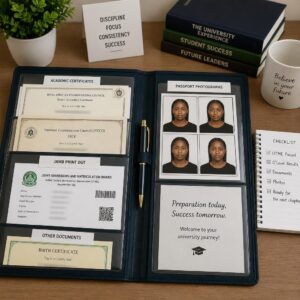
Every year, thousands of Nigerian students complete their final examinations and expect a smooth transition from campus life to graduation, NYSC mobilization, and eventually the job market. But for many, this transition turns into a frustrating, time-consuming, and sometimes costly ordeal.
Some discover that their names are missing from the graduation list. Others find out their course registration from second year was never properly captured. Some get to the NYSC portal and realize they cannot be mobilized because of unresolved issues with their institution. A few even learn — sometimes years after leaving campus — that their results were withheld because of an unpaid library fine or an incomplete clearance process.
These problems are preventable. In most cases, they happen because students do not take certain essential steps before leaving their institutions. They assume everything is in order simply because they wrote their final exams.
This article is a comprehensive guide for Nigerian university students, polytechnic students, and College of Education students. It covers everything you should do before graduation to avoid problems with clearance, academic results, transcripts, certificates, and NYSC mobilization. Whether you are in your final year right now or still have a few semesters left, this guide will help you protect yourself from the delays and difficulties that catch many Nigerian graduates off guard.
Quick Summary: What You Must Do Before Graduation
Before you leave your institution after your final exams, make sure you have:
- Confirmed that all your course registrations from Year 1 to final year are correctly captured
- Resolved any outstanding fees, fines, or financial obligations
- Completed departmental, faculty, and university-wide clearance
- Confirmed that all your results are complete and correctly uploaded
- Verified that your biodata on your institution’s portal matches your official documents
- Confirmed that your O’level results are properly uploaded on JAMB’s portal
- Addressed any carryover courses or missing grades
- Obtained all necessary signatures and stamps for clearance forms
- Checked your JAMB records for correctness
- Started preparing your NYSC documentation early
The rest of this article explains each of these steps in detail, with practical advice specific to Nigerian tertiary institutions.
Why Pre-Graduation Preparation Matters So Much in Nigeria
In an ideal system, finishing your final exams would be enough. Your results would appear on the portal, your clearance would be automatic, and you would be mobilized for NYSC without complications.
But the Nigerian education system involves multiple administrative layers, manual processes, and institutional bureaucracies that can create gaps. A single missing signature, an unresolved registration error, or a name mismatch can delay your graduation and NYSC mobilization by months — or even years.
Here is why preparation before graduation matters:
1. Administrative processes are not always automatic. Many Nigerian institutions still rely partly on manual records. If you do not verify your records personally, errors may go unnoticed until it is too late.
2. Clearance involves multiple departments. You may need to clear with the library, student affairs, your department, your faculty, the bursary, the health centre, the sports unit, and other offices. Missing any of these can hold up your graduation.
3. NYSC mobilization depends on your institution. Your institution uploads your data to the NYSC portal. If your records are incomplete or incorrect at your institution, NYSC will not mobilize you.
4. Correcting problems after leaving campus is far more difficult. Once you leave campus, fixing a missing course registration or a name discrepancy becomes much harder. You may have to travel repeatedly, spend money, and deal with staff who are less responsive when you are no longer an active student.
5. Some problems have strict deadlines. Certain corrections — such as JAMB data corrections, course registration amendments, and O’level result uploads — have specific windows. Missing these windows can cause serious delays.
Taking proactive steps while you are still on campus, while you still have access to offices, portals, and lecturers, is the most effective way to protect yourself.
Step 1: Verify All Your Course Registrations From Year 1 to Final Year
This is arguably the single most important thing you can do before graduation. Course registration problems are among the most common causes of delayed results and graduation issues in Nigerian institutions.
Why Course Registration Errors Happen
- Students sometimes register courses online but do not confirm that the registration was saved.
- Portal glitches during registration periods can cause courses to disappear from a student’s record.
- Some students register late and their registrations are not captured.
- Changes in course codes or curriculum updates can create mismatches.
- Department-level manual registration records may not match the central portal.
- Some students fail to register for courses they assumed were automatically carried over.
What You Should Do
- Log in to your institution’s student portal and download or print your course registration forms for every semester and every academic session from when you started.
- Check every single course. Make sure the course title, course code, credit units, and semester are correctly listed for each session.
- Cross-reference with your department. Visit your departmental office and ask to verify your course registration records on their end. In some institutions, the department keeps a separate record. Make sure both the central portal and the departmental records match.
- Look for missing courses. If any course you took is missing from your registration, report it immediately. You may need to write a formal letter to the head of department or the dean of the faculty, depending on your institution’s procedures.
- Confirm carryover course registrations. If you carried over any course and re-registered it, confirm that the new registration is properly captured.
- Print and keep copies. Print hard copies of every registration form. Keep them safely. These are your evidence that you registered for those courses.
What Happens If You Ignore This
If a course you took is missing from your official registration, your result for that course may not be processed. Even if your lecturer has your exam script and recorded a grade, the system may not recognize the result because there is no matching registration record. This can lead to an “incomplete results” status that blocks your graduation and NYSC mobilization.
Step 2: Confirm That All Your Results Are Complete and Correctly Uploaded
Even if your course registrations are correct, your results need to be properly uploaded for graduation processing.
Common Result Problems
- Missing grades for courses you registered and took.
- Incorrect grades due to data entry errors.
- Grades showing as “I” (Incomplete) or “ABS” (Absent) even though you sat for the examination.
- Results for a whole semester missing because of departmental delays in uploading.
- Carryover grades not reflecting even after you retook the course.
What You Should Do
- Check your results on your institution’s portal for every semester. Do not just check your final year results. Go through every session.
- Identify any missing or incorrect grades immediately. If you notice a problem, report it to your course adviser, head of department, or the relevant lecturer.
- Follow up persistently but respectfully. In some institutions, result corrections require the lecturer to write to the head of department, who then writes to the exam and records unit. This process can take time, so start early.
- Keep evidence of your coursework. If you have continuous assessment scores, test scripts, or any other proof that you participated in a course, keep them. They may be needed if a dispute arises.
- Check your CGPA calculation. Use your institution’s grading system to independently calculate your CGPA. If the portal shows a CGPA that does not match your calculations, investigate the cause.
- Resolve carryover courses. If your portal shows outstanding carryover courses, find out whether the grades have been submitted. If the course was recently taken, it may take time for the results to appear, but you should confirm with the relevant department.
What Happens If You Ignore This
If your results are incomplete, your institution will not include your name on the graduation list. You will not be cleared, and your data will not be submitted to NYSC. Some students discover missing results only after waiting for months to be mobilized for NYSC, and then they have to return to campus to begin the correction process from scratch.
Step 3: Clear All Outstanding Financial Obligations
Financial holds are one of the most common reasons students face clearance problems. Many Nigerian institutions will not process your clearance or release your results if you owe any amount of money.
Types of Financial Obligations to Check
- Tuition fees: Confirm that your tuition has been fully paid for every session. Even a small balance from a previous year can create problems.
- Acceptance fees: If you did not pay your acceptance fee at the time of admission, some institutions flag this during clearance.
- Departmental fees or levies: Some departments charge additional fees for laboratory use, project supervision, fieldwork, or other activities.
- Hostel fees: If you stayed in university accommodation, make sure all hostel charges are settled.
- Library fines: Overdue book fines, lost book charges, or unreturned materials can result in a library hold on your account.
- Medical or health centre fees: Some institutions charge health service fees that students overlook.
- Sports or recreational facility fees: In some institutions, these are separate charges.
- Sundry charges: Late registration penalties, ID card replacement fees, and other miscellaneous charges.
What You Should Do
- Visit your institution’s bursary or fees department and ask for a complete statement of your financial account. Confirm that every payment you have made is reflected.
- Keep all payment receipts. If there is a discrepancy between what the bursary shows and what you actually paid, your receipts are your proof.
- Check your portal for outstanding fees. Many institutions display fee balances on the student portal.
- Resolve any disputes early. If you believe a charge is incorrect, raise the issue formally. Write a letter or submit a complaint through the appropriate channel. Do not wait until clearance day.
- Pay off any genuine outstanding amounts. It is far better to settle a small unpaid fee now than to deal with the consequences after graduation.
What Happens If You Ignore This
Your institution may place a financial hold on your account, which prevents clearance, blocks result processing, and delays your graduation. In some cases, students have had their certificates withheld for years because of an unpaid charge they were unaware of.
Step 4: Complete Your Departmental, Faculty, and University Clearance
Clearance is the formal process through which your institution confirms that you have met all requirements to graduate. It typically involves multiple stages and multiple offices.
Understanding the Clearance Process
Most Nigerian institutions require you to obtain clearance from several units. While the exact process varies by institution, a typical clearance procedure includes the following:
| Clearance Stage | What Is Required |
|---|---|
| Departmental clearance | Submission of project/thesis, confirmation of completed courses, return of departmental equipment or materials |
| Faculty clearance | Verification by the faculty office, confirmation of departmental clearance |
| Library clearance | Return all borrowed books and materials, settle outstanding fines |
| Bursary clearance | Confirmation that all fees and charges are paid |
| Student Affairs clearance | Return of ID card or confirmation of student records |
| Health Centre clearance | Confirmation that health records are complete |
| Sports clearance | Return of any sports equipment, confirmation of no outstanding issues |
| ICT/MIS clearance | Verification of portal records, sometimes a data verification form |
| Security clearance | Some institutions require a security clearance stamp |
| Hostel clearance | Confirmation that your room has been vacated and inspected (if you used university accommodation) |
What You Should Do
- Find out your institution’s specific clearance requirements. Visit the student affairs office, your departmental office, or check the institution’s portal or notice boards for the clearance procedure.
- Obtain the clearance form early. Do not wait until the deadline. Collect the form as soon as it is available.
- Start with the offices that are most likely to have issues. If you know you owe library books or have a fee balance, resolve those first.
- Visit each office personally. Do not rely on friends or unofficial agents to handle your clearance unless your institution formally allows representatives.
- Get signatures and stamps at each point. Each clearance unit will typically sign or stamp your clearance form. Make sure each section is properly completed.
- Photocopy your completed clearance form. After obtaining all the necessary signatures, make copies before submitting the original. Keep a copy for your personal records.
- Submit the clearance form before the deadline. Late submission can delay your graduation.
What Happens If You Ignore This
Without completed clearance, your institution will not process your graduation. Your name may be excluded from the graduation list, your certificate may be withheld, and your records may not be submitted to NYSC.
Step 5: Verify Your Biodata on All Relevant Platforms
Name discrepancies and biodata errors are a surprisingly common source of problems for Nigerian graduates, especially during NYSC mobilization.
Where Biodata Errors Cause Problems
- Your institution’s portal — If your name is misspelled, your date of birth is wrong, or your state of origin is incorrectly recorded, it can affect your clearance and NYSC mobilization.
- JAMB portal — NYSC uses JAMB data for verification. If your name or details on JAMB’s portal do not match your institution’s records, you may face mobilization problems.
- WAEC/NECO portal — If the name on your O’level result does not match the name on your JAMB registration or institution records, it can create issues.
- NYSC portal — When your institution submits your data, any mismatch can result in rejection during mobilization.
Common Biodata Problems
- Spelling variations (e.g., “Muhammed” vs. “Mohammed” vs. “Muhammad”)
- Name rearrangement (e.g., surname and first name swapped)
- Missing middle name on one platform but present on another
- Wrong date of birth
- Wrong state of origin or local government area
- Wrong gender marker
- Different names on O’level result and JAMB profile
What You Should Do
- Check your name, date of birth, gender, state of origin, and local government area on your institution’s portal. Make sure they are correct and consistent with your other documents.
- Log in to your JAMB profile (via the JAMB portal at jamb.gov.ng) and confirm your personal details. If there are errors, apply for a correction through JAMB’s official process. JAMB data corrections typically require visiting a JAMB office or using the JAMB portal’s correction feature, and there may be a fee.
- Check your WAEC or NECO result. Confirm that the name on your O’level result matches the name on your JAMB profile and your institution’s records. If there is a difference, you may need to process a name correction with WAEC or NECO, or obtain an affidavit to explain the discrepancy.
- Check your institution’s records office. Some institutions have a records or registry unit where you can verify what name and details they have on file for you.
- Resolve any discrepancies while you are still a student. Correcting a name error at your institution is generally easier while you are still enrolled. After graduation, you may face longer processes and additional fees.
- Get a sworn affidavit if needed. If your name differs slightly between documents (for example, if you have a different middle name on your O’level result and your JAMB profile), you may need an affidavit from a court to reconcile the difference. This is a common practice, and courts near most institutions handle these affidavits regularly.
What Happens If You Ignore This
If your details do not match across platforms, NYSC may reject your mobilization data. You could also face problems collecting your certificate, processing transcripts, or applying for jobs that require document verification. Some graduates have been delayed for entire NYSC batches — or even multiple batches — because of name mismatches that could have been resolved before graduation.
Step 6: Ensure Your O’Level Results Are Properly Uploaded and Verified
Your O’level results (WAEC, NECO, or NABTEB) play a continuing role even after you have been admitted to a tertiary institution. They are verified during clearance, and they are part of the data reviewed during NYSC mobilization.
Common O’Level Result Problems
- Awaiting results at the time of admission. If you were admitted with awaiting results and have since obtained your O’level result, you need to ensure that the result has been submitted to your institution and to JAMB.
- O’level results not uploaded on JAMB portal. JAMB requires that your O’level result be linked to your JAMB profile. If this was not done or was done incorrectly, it can cause problems during NYSC mobilization.
- Incorrect O’level result details on JAMB portal. Sometimes the examination number, subject grades, or year of examination entered on the JAMB portal may contain errors.
- Withheld or cancelled O’level results. If WAEC or NECO withheld or cancelled your result (e.g., due to examination malpractice or investigation), this can affect your status.
- Two sittings not properly documented. If you used two O’level sittings for admission, both results need to be properly recorded.
What You Should Do
- Confirm that your O’level result is linked to your JAMB profile. Log in to your JAMB profile and check whether your WAEC, NECO, or NABTEB result details are correctly uploaded.
- If your result is not uploaded, upload it immediately. You can do this through the JAMB portal or by visiting a JAMB office.
- If you were admitted with awaiting results, submit your result to your institution. Visit the admissions office or the registry to confirm that your O’level result has been received and recorded.
- Verify that the grades and subjects are correctly captured. Check each subject carefully. An error in a single grade can cause problems during verification.
- If you used two sittings, confirm that both results are properly linked. Some students who combined two O’level results for admission find that only one sitting is recorded on their JAMB profile or institution records.
- Keep original and photocopies of your result(s). Always have your original O’level result(s) available. You will need them for clearance, NYSC, and employment.
What Happens If You Ignore This
If your O’level result is not properly linked to your JAMB profile, NYSC may not mobilize you. If your institution does not have a copy of your O’level result, they may not clear you for graduation. If there are errors in the O’level data on any platform, you may need to correct them — a process that takes time and may involve visiting WAEC, NECO, or JAMB offices.
Step 7: Submit Your Final Year Project or Thesis Properly
In most Nigerian tertiary institutions, submitting your final year project, thesis, or long essay is a mandatory requirement for graduation. Failing to submit it properly — or submitting it late — can delay your clearance and result processing.
What You Should Do
- Confirm your institution’s submission requirements. Find out the exact format, number of copies, binding specifications, and submission deadline for your project.
- Get your supervisor’s approval before binding. Many institutions require a signed approval page from your project supervisor before you bind and submit. Do not bind your project without this approval.
- Include all required pages and sections. These typically include:
- Title page
- Certification page (with supervisor’s signature)
- Dedication
- Acknowledgments
- Abstract
- Table of contents
- Main body chapters
- References
- Appendices
- Submit the required number of copies. Most institutions require at least two or three bound copies — one for the department, one for the faculty, and sometimes one for the university library.
- Get a submission acknowledgment. When you submit your project copies, ask for a receipt or written acknowledgment. This proves that you submitted on time.
- Keep a personal copy. Always keep at least one copy of your bound project for your own records.
- Submit soft copies if required. Some institutions now require an electronic copy of the project to be submitted via email or uploaded to a plagiarism-checking system.
What Happens If You Ignore This
If your project is not submitted, your results for the final year may be incomplete. Some institutions will not process your degree classification until your project is graded and recorded. In extreme cases, students have had to return to campus months after finishing exams to resolve project submission issues.
Step 8: Return All Borrowed Materials and Equipment
This may seem minor, but it causes more clearance problems than most students expect.
Items You May Need to Return
- Library books
- Laboratory equipment
- Departmental tools or instruments
- Sports equipment
- Hostel keys or bedspace allocations
- ID cards
- Any other institutional property
What You Should Do
- Check with the library. Confirm that you have no outstanding borrowed books or materials. If you do, return them immediately. If you have lost a book, find out the replacement or fine amount and pay it.
- Return any departmental equipment. If your course required you to borrow laboratory equipment, tools, or other items, return them before clearance.
- Clear your hostel room properly. If you stayed in university accommodation, vacate and clean the room according to the hostel rules. Some institutions require a room inspection before issuing hostel clearance.
- Return your student ID card if required. Some institutions collect student ID cards during clearance. Others allow you to keep it. Find out your institution’s policy.
What Happens If You Ignore This
Any unreturned item can result in a hold on your clearance. Library holds, in particular, are very common. Some institutions will not release your certificate until a library hold is resolved, even if the issue is a single unreturned book from your second year.
Step 9: Confirm Your JAMB Admission Records
This step is often overlooked, but it can cause serious problems during NYSC mobilization.
NYSC verifies your admission through JAMB’s Central Admissions Processing System (CAPS). If JAMB’s records do not show that you were properly admitted, or if there is a discrepancy between your JAMB records and your institution’s records, your NYSC mobilization can be delayed or blocked.
Common JAMB Record Issues
- Admission not reflected on JAMB CAPS
- Admission status showing “Not Admitted” even though you attended the institution
- Institution or course on JAMB records different from what you actually studied
- JAMB regularization not completed for students who need it
- Direct Entry candidates whose admission was not properly processed on JAMB’s system
What You Should Do
- Log in to your JAMB profile and check your admission status. It should show that you were admitted to the institution and course you studied.
- If your JAMB admission status does not match your actual admission, investigate immediately. Contact your institution’s admissions office to find out why there is a discrepancy.
- If you need JAMB regularization, process it before graduation. Some students were admitted without proper JAMB processing (for example, students who gained admission through institutional processes without going through JAMB CAPS, or students who changed courses or institutions without updating JAMB). JAMB regularization corrects this by officially recording your admission on JAMB’s system. There is a fee for regularization, and it is done through the JAMB portal or a JAMB office.
- Direct Entry students should confirm their DE admission is on JAMB’s system. Direct Entry candidates sometimes face unique problems because their admission pathway is different. Confirm that your Direct Entry admission is properly captured.
- If you changed course or institution after initial admission, make sure the change is reflected on JAMB. If JAMB still shows your old course or institution, you will need to update it.
What Happens If You Ignore This
NYSC will not mobilize you if your JAMB admission records do not align with your institution’s records. This is one of the most common reasons for NYSC rejection, and it can take weeks or months to resolve after the fact. Resolving it while you are still a student is much easier and faster.
Step 10: Begin Your NYSC Preparation Early
While NYSC registration and mobilization happen after graduation, several preparatory steps should begin before you leave campus.
NYSC Pre-Mobilization Checklist
- Confirm your date of birth. NYSC has an age limit. You must be below 30 years of age at the time of graduation to be eligible for NYSC. If you are above 30, you are entitled to an exemption letter instead. Confirm that your date of birth on all platforms is correct.
- Confirm your institution will upload your data. After you graduate, your institution is responsible for uploading your details to the NYSC portal. Ask your department or the institution’s NYSC desk officer when this data upload is expected to happen.
- Keep all your documents ready. You will need the following for NYSC mobilization:
- JAMB admission letter or JAMB result slip
- O’level result(s)
- Statement of result or notification of result from your institution
- Degree certificate (if available; otherwise, statement of result)
- Evidence of state of origin (birth certificate, declaration of age, or local government identification letter)
- Passport photographs
- National ID (NIN)
- Medical fitness certificate (sometimes required at camp)
- Obtain your statement of result. Many institutions issue a statement of result before the formal certificate is ready. Find out when and how to collect yours. You will likely need it for NYSC registration.
- Check NYSC mobilization batches. NYSC mobilizes graduates in batches (Batch A, B, and sometimes C) each year. Find out when your institution typically submits data for mobilization and which batch you are likely to fall into.
- Set up or verify your NYSC online account. The NYSC portal is at portal.nysc.org.ng. You may need to register or update your profile when mobilization begins. Having your details ready in advance makes the process smoother.
What Happens If You Ignore This
Students who do not prepare for NYSC often face delays in mobilization. Some arrive at the point of NYSC registration and discover that their institution has not uploaded their data, their JAMB records have errors, or their documents have discrepancies. By then, fixing these problems can delay mobilization by months.
Step 11: Secure Copies of All Important Academic Documents
Before you leave campus for the last time, make sure you have copies of every important academic document.
Documents to Collect or Copy
| Document | Why You Need It |
|---|---|
| Course registration forms (all semesters) | Proof that you registered for all required courses |
| Results printout (all semesters) | Verification of grades and CGPA |
| Statement of result | Used for NYSC registration and job applications |
| Clearance form (copy) | Proof that you completed clearance |
| Admission letter | Required for NYSC and some job applications |
| JAMB result slip | Verification of your admission |
| Project submission receipt | Proof that your project was submitted |
| Payment receipts | Proof of financial clearance |
| Student ID card (or copy) | Identification as a graduate of the institution |
| Transcript request form (if submitted) | Tracking your transcript application |
What You Should Do
- Print hard copies of all portal-based documents. Portals can change, be updated, or become inaccessible after graduation. Do not rely solely on digital access.
- Photocopy all documents. Keep at least two sets of photocopies in separate, safe locations.
- Save digital copies. Download PDFs of your registration forms, results, and any other documents available on the portal. Save them on a secure device and in cloud storage.
- Collect your statement of result. Find out from your institution when the statement of result will be ready and how to collect it. Some institutions mail it; others require personal collection.
- Apply for your transcript early if needed. If you plan to apply for postgraduate programmes (either in Nigeria or abroad), you may need official transcripts. The transcript application process can take time — sometimes months — depending on the institution. Apply before or shortly after graduation.
What Happens If You Ignore This
Without proper documentation, you may struggle with NYSC registration, job applications, postgraduate applications, and professional registrations. Some graduates have been unable to prove their qualifications because they lost their only copies of critical documents and their institution’s portal was no longer accessible.
Step 12: Address Any Disciplinary or Academic Issues
If you have any pending disciplinary cases, academic misconduct allegations, or examination irregularity issues, resolve them before graduation.
Types of Issues to Resolve
- Pending examination malpractice cases
- Academic probation that has not been lifted
- Outstanding disciplinary panel hearings
- Letters of warning that require a formal response
- Issues with project originality or plagiarism
- Attendance or participation disputes
What You Should Do
- Check with your department and the student disciplinary committee to confirm that you have no pending cases.
- If you have a pending case, attend all hearings and cooperate with the process. Ignoring a disciplinary case does not make it go away. In some institutions, unresolved cases result in withheld results.
- If you were placed on academic probation, confirm that it has been formally lifted. Check your portal and your departmental records.
- If you received a letter of warning or query, confirm that it has been resolved and documented.
- Keep copies of any resolution letters or clearance letters related to disciplinary matters.
What Happens If You Ignore This
Unresolved disciplinary matters can result in your results being withheld, your graduation being delayed, or even your expulsion from the institution. Addressing these issues before graduation is essential.
Step 13: Update Your Contact Information
This seems simple, but it is important. After graduation, your institution or NYSC may need to contact you. If they cannot reach you, you may miss important deadlines or announcements.
What You Should Do
- Update your phone number and email address on your institution’s portal. Make sure these are current and accessible.
- Update your contact details with your department. Leave a reliable phone number with your departmental secretary or office.
- Use a personal email address. Some institutions provide student email addresses that are deactivated after graduation. Make sure you have a personal email address that you will continue to use.
- Join relevant alumni or class groups. Your classmates and alumni networks can be valuable sources of information about graduation ceremonies, certificate collection, and NYSC updates.
- Monitor your institution’s official channels. Follow your institution’s website and official social media accounts for announcements about graduation, certificate collection, and NYSC mobilization.
Step 14: Understand the Graduation List Process
In most Nigerian institutions, the graduation list is not the same as the senate-approved list. Understanding how this process works can help you avoid panic and take the right steps if your name is missing.
How the Graduation List Typically Works
- Department-level compilation. Your department compiles a list of final-year students who have completed all requirements.
- Faculty-level verification. The faculty reviews the departmental list and confirms that all requirements are met.
- Senate approval. The university senate (or the equivalent body in polytechnics and colleges of education) reviews and approves the final graduation list.
- Publication. The approved list is published, and students whose names appear are eligible to participate in the graduation ceremony and receive their certificates.
What You Should Do
- After your final exams, check the departmental list. When your department publishes its preliminary list of graduating students, confirm that your name is on it.
- If your name is missing, act immediately. Visit the head of department or your course adviser to find out why. Common reasons include incomplete results, outstanding clearance, or administrative errors.
- Follow up at each stage. Check the faculty-level list and the senate-approved list as they become available.
- Do not assume everything is fine just because you finished your exams. The graduation list is based on completed requirements, not just completed exams.
What Happens If You Ignore This
Some students discover that their name is missing from the graduation list only on the day of the ceremony. By then, it may be too late to resolve the issue before the next graduation cycle, which could be a year or more away.
Step 15: Know What to Do If You Encounter Problems
Despite your best efforts, problems may still arise. Here is how to handle common issues.
Problem 1: Missing Results
What to do:
- Identify which course result is missing.
- Contact the lecturer for that course.
- Visit the head of department.
- Write a formal letter to the examination and records unit.
- Follow up regularly.
Problem 2: Name Mismatch
What to do:
- Identify where the mismatch exists (institution, JAMB, WAEC/NECO, NYSC).
- Obtain a sworn affidavit if needed.
- Apply for a name correction through the relevant body.
- Provide supporting documents.
Problem 3: JAMB Records Not Matching
What to do:
- Visit your institution’s JAMB liaison officer.
- Apply for regularization if needed.
- Visit a JAMB office for correction.
- Provide original documents for verification.
Problem 4: Clearance Form Not Complete
What to do:
- Identify which office has not cleared you.
- Resolve any outstanding issue with that office.
- Obtain the necessary signature or stamp.
- Resubmit the clearance form.
Problem 5: Financial Hold on Your Account
What to do:
- Visit the bursary and obtain a detailed statement.
- Pay any genuine outstanding amount.
- If there is an error, present your payment receipts as evidence.
- Request a written confirmation of clearance from the bursary.
Problem 6: Project Not Graded
What to do:
- Contact your project supervisor.
- If necessary, escalate to the head of department.
- Confirm that the project has been submitted and recorded.
Problem 7: NYSC Portal Rejection
What to do:
- Check the specific reason for rejection on the NYSC portal.
- Contact your institution’s NYSC desk officer.
- Resolve the issue identified (usually a data mismatch, missing O’level result, or JAMB record problem).
- Re-upload your details or ask your institution to correct and re-upload your data.
A Complete Pre-Graduation Checklist for Nigerian Students
Use this checklist to track your preparation. Ideally, start working through this list at least one semester before your expected graduation.
Academic Records
- All course registrations from Year 1 to final year verified
- All results complete and correctly uploaded
- CGPA checked and confirmed
- All carryover courses passed and results recorded
- Final year project submitted with all required copies
- Project submission receipt obtained
Financial Clearance
- All tuition fees paid in full
- All departmental fees and levies paid
- Hostel fees cleared (if applicable)
- Library fines paid
- Health centre fees cleared
- Bursary statement obtained confirming zero balance
Clearance Process
- Clearance form collected
- Departmental clearance completed
- Faculty clearance completed
- Library clearance completed
- Bursary clearance completed
- Student affairs clearance completed
- Health centre clearance completed
- Sports unit clearance completed
- ICT/MIS clearance completed
- Hostel clearance completed (if applicable)
- All signatures and stamps obtained
- Clearance form photocopied
- Clearance form submitted before deadline
Biodata Verification
- Name verified on institution portal
- Date of birth verified on institution portal
- State of origin and LGA verified
- JAMB profile details checked and confirmed
- O’level result details checked on JAMB portal
- Name consistency confirmed across all documents
- Affidavit obtained (if name discrepancy exists)
O’Level Results
- O’level result(s) uploaded on JAMB portal
- O’level result(s) submitted to institution (if admitted with awaiting result)
- Both sittings properly linked (if applicable)
JAMB Records
- JAMB admission status verified on JAMB portal
- Institution and course on JAMB records match actual institution and course studied
- JAMB regularization completed (if needed)
Document Collection
- Course registration forms printed for all semesters
- Results printout saved (hard and soft copy)
- Admission letter available
- JAMB result slip available
- Statement of result collected (or application submitted)
- Transcript applied for (if needed)
- Project copy retained
- Payment receipts saved
NYSC Preparation
- Date of birth confirmed for NYSC eligibility
- All required documents gathered
- Institution’s NYSC data upload timeline confirmed
- NYSC portal account set up or verified
- Passport photographs ready
Contact Information
- Phone number and email updated on institution portal
- Personal (non-institutional) email address active
- Departmental office has current contact details
- Joined relevant alumni or class communication groups
Common Mistakes Nigerian Students Make Before Graduation
Mistake 1: Assuming Everything Is Automatically in Order
Many students believe that once they finish their exams, everything else happens automatically. It does not. Course registrations, results, clearance, and NYSC mobilization all require active participation and verification from the student.
Mistake 2: Waiting Until the Last Minute to Start Clearance
Clearance involves multiple offices, and some of them are slow. Starting your clearance on the last day almost guarantees problems. Begin the process as early as your institution allows.
Mistake 3: Not Checking Course Registration Records
Students who never check their registration records are often surprised when results are missing for courses they took. Always verify your registrations every semester, not just in your final year.
Mistake 4: Ignoring Small Financial Obligations
A library fine of a few hundred naira can place a hold on your entire academic record. Do not ignore small charges. Clear everything.
Mistake 5: Not Keeping Copies of Documents
Losing your only copy of a payment receipt, registration form, or admission letter can create enormous problems. Always keep multiple copies in multiple locations.
Mistake 6: Ignoring Name Discrepancies
Students often know that their name is spelled differently on their WAEC result and their JAMB profile but do nothing about it. This can block NYSC mobilization. Fix it before graduation.
Mistake 7: Not Confirming JAMB Admission Records
Some students go through four or five years of university without ever checking whether JAMB’s records show them as admitted. When they try to register for NYSC, they discover the problem. Check your JAMB records early.
Mistake 8: Leaving Campus Without Collecting the Statement of Result
Your statement of result is often your primary proof of qualification until your certificate is ready. Some institutions take months or years to issue the certificate. Collect your statement of result as soon as it is available.
Mistake 9: Relying on Agents or Third Parties for Clearance
Some students pay agents to handle their clearance. While this may work in some cases, it can also lead to incomplete clearance, fraudulent stamps, or missing documents. Handle your clearance personally whenever possible.
Mistake 10: Not Following Up After Graduation
After leaving campus, some students simply wait for NYSC to call without following up on their results, clearance, or data upload. Stay proactive. Contact your institution’s NYSC desk officer, check your NYSC portal, and monitor your email.
Special Considerations for Polytechnic and College of Education Students
While much of this guide applies to all Nigerian tertiary institutions, polytechnic and College of Education students should be aware of some additional considerations.
Polytechnic Students
- ND and HND certification. If you are completing a National Diploma (ND) programme, you will receive an ND certificate. If you are completing a Higher National Diploma (HND), you will receive an HND certificate. The clearance and result processes are similar to universities but may involve different offices and different timelines.
- NBTE accreditation. Confirm that your programme is accredited by the National Board for Technical Education (NBTE). An unaccredited programme can cause problems with NYSC mobilization and employment.
- Industrial Training (IT/SIWES). Polytechnic students are usually required to complete industrial training. Confirm that your IT/SIWES records are complete and properly documented before graduation.
- Logbook submission. If your programme requires a logbook from your industrial training, make sure it has been submitted, assessed, and graded.
College of Education Students
- NCE certification. College of Education students receive the Nigeria Certificate in Education (NCE). The clearance process follows a similar pattern but may involve the institution’s academic board rather than a university senate.
- Teaching practice records. College of Education students are typically required to complete teaching practice. Confirm that your teaching practice records, assessments, and supervision reports are complete.
- NCCE accreditation. Confirm that your programme is accredited by the National Commission for Colleges of Education (NCCE).
- NYSC eligibility for NCE holders. NCE is a diploma-level qualification. Historically, NCE holders have been required to participate in NYSC. However, policies can change, and the duration of service may differ. Confirm the current NYSC policy for NCE holders.
Special Considerations for Direct Entry Students
If you were admitted through Direct Entry (using an ND, NCE, IJMB, A-Level, or similar qualification), pay special attention to your JAMB Direct Entry records.
What Direct Entry Students Should Verify
- Confirm that your Direct Entry admission is on JAMB’s system. Some DE students find that their admission was not properly captured by JAMB.
- If you need regularization, process it before graduation. Direct Entry students who were not properly registered through JAMB may need to regularize their admission.
- Confirm that your previous qualification (ND, NCE, etc.) is properly documented. Your institution and NYSC may need to verify your previous qualification.
- Check the course and institution recorded on JAMB for DE. Make sure the JAMB records reflect the correct institution and course you studied as a DE student.
What to Do If You Have Already Graduated and Are Facing Problems
If you are reading this after graduation and are already experiencing problems, here are some steps to take.
Missing Results
- Contact your department immediately.
- Write a formal letter to the head of department explaining the issue.
- Visit the examination and records unit.
- Follow up consistently until the issue is resolved.
Clearance Not Complete
- Find out which clearance stage is incomplete.
- Visit the relevant office and resolve the outstanding issue.
- Complete and resubmit the clearance form.
NYSC Mobilization Rejected
- Check the NYSC portal for the specific reason for rejection.
- Contact your institution’s NYSC desk officer.
- Resolve the identified issue (data mismatch, missing O’level result, JAMB problem).
- Request that your institution re-upload your data.
Name Mismatch
- Obtain a sworn affidavit if needed.
- Apply for correction at the relevant body (JAMB, WAEC/NECO, or your institution).
- Provide supporting documents.
JAMB Records Problem
- Visit a JAMB office or use the JAMB portal.
- Apply for regularization or correction.
- Pay the applicable fee.
- Provide your original documents.
Certificate Not Ready
- Contact the registrar’s office to find out the expected timeline.
- Collect your statement of result in the meantime.
- Some institutions allow graduates to apply for the certificate and have it mailed or collected later.
Transcript Delayed
- Follow up with the transcript unit or registrar’s office.
- Confirm that your application and payment were received.
- Be aware that transcript processing times vary widely between institutions. Some take weeks; others take months.
How Long Does Clearance and Result Processing Usually Take?
This varies significantly between institutions. Here is a general estimate, though your institution’s timeline may be different:
| Process | Typical Duration |
|---|---|
| Departmental clearance | 1–4 weeks |
| Faculty clearance | 1–3 weeks |
| Full university clearance | 2–8 weeks |
| Result compilation and upload | 2–12 weeks after final exams |
| Senate approval of graduation list | Varies (may take months) |
| Statement of result availability | 1–6 months after graduation |
| Certificate production | 6 months to 2+ years (varies widely) |
| NYSC data upload by institution | Varies per mobilization batch |
| Transcript processing | 2 weeks to 6+ months |
These are estimates, not guarantees. Your institution’s timelines may differ.
Important Contacts and Resources
Before you leave campus, note down or save the following contact information:
- Head of Department office — phone number, email, office hours
- Faculty Dean’s office — contact details
- Registrar’s office — contact details
- Bursary department — contact details
- Library — contact details
- Student Affairs — contact details
- Examination and Records unit — contact details
- NYSC desk officer — contact details
- Institution’s official website — URL
- Institution’s student portal — URL
- JAMB portal — jamb.gov.ng
- NYSC portal — portal.nysc.org.ng
- WAEC result checking — waecdirect.org
- NECO result checking — result.neco.gov.ng
Having these contacts readily available will save you time and effort if you need to resolve any issue after leaving campus.
Frequently Asked Questions
1. When should I start my pre-graduation preparation?
Ideally, at least one full semester before your expected graduation. Some steps, like verifying your course registrations and resolving financial obligations, should actually be done every semester throughout your programme. But at the very latest, start your clearance and document verification process at the beginning of your final semester.
2. What if my institution’s portal is down and I cannot check my records?
Try again later. If the portal is down for an extended period, visit the relevant offices in person — your department, the ICT unit, the examination and records unit — and ask for manual verification of your records.
3. Can someone else handle my clearance on my behalf?
This depends on your institution’s policy. Some institutions allow representatives with a valid authorization letter; others require personal presence. However, it is generally safer and more reliable to handle your clearance yourself. You are the one who knows your records best.
4. What if I have a carryover course that I have not passed before my final year?
You will need to register for and pass the carryover course before you can graduate. If the course is still outstanding at the end of your final year, your graduation will be delayed until you have passed it and the result is recorded. Speak to your head of department or course adviser about your options.
5. What if my name on my O’level result is different from my name on my JAMB profile?
You will need to resolve this discrepancy. Options include:
- Obtaining a sworn affidavit that reconciles the two names.
- Applying for a name correction with WAEC, NECO, or JAMB (depending on where the error is).
- Submitting the affidavit along with your documents during clearance and NYSC registration.
Start this process as early as possible, as it can take time.
6. How do I know if I need JAMB regularization?
You may need JAMB regularization if:
- Your JAMB profile does not show you as admitted to your institution.
- You were admitted without going through JAMB CAPS (this is more common in certain admission scenarios).
- You changed course or institution after JAMB admission and the change was not reflected on JAMB’s system.
- You are a Direct Entry candidate whose DE admission was not captured by JAMB.
Log in to your JAMB profile to check your admission status. If it does not reflect your actual admission, you likely need regularization.
7. What happens if my institution does not upload my data to NYSC?
If your institution does not upload your data, you will not be able to register on the NYSC portal for mobilization. Contact your institution’s NYSC desk officer to find out the upload schedule and confirm that your data has been submitted. If there is a delay, follow up persistently.
8. Is it possible to be mobilized for NYSC before receiving my certificate?
Yes. Most graduates are mobilized for NYSC using their statement of result (also called notification of result), not their degree certificate. Certificates often take months or years to be produced. Your statement of result, along with your other documents, is usually sufficient for NYSC registration.
Conclusion
Graduating from a Nigerian tertiary institution should be an exciting achievement, not the beginning of a long and frustrating administrative struggle. Yet every year, thousands of graduates face avoidable problems with clearance, results, and NYSC mobilization because they did not take essential steps before leaving campus.
The good news is that almost all of these problems are preventable. By verifying your course registrations, confirming your results, clearing your financial obligations, completing your clearance process, checking your biodata across all relevant platforms, confirming your JAMB records, and preparing your documents for NYSC, you can ensure a smooth transition from student to graduate.
Start early. Be thorough. Keep copies of everything. Follow up persistently. And do not assume that everything is in order just because you wrote your final exams.
If you are currently a final-year student, use the checklist in this article as your guide. If you still have a few semesters left, start building good habits now — check your registrations every semester, keep your receipts, and stay on top of your records. Your future self will thank you.
For any verification or confirmation of specific institutional policies, always check with your institution’s official offices or visit their official website. Policies and procedures can change, and the most reliable source of information is always the relevant institution itself.