Can a Candidate With Awaiting O’Level Result Still Gain Admission Into a Nigerian University?
You have registered for JAMB. You have written your UTME — or you are about to. Your WAEC, NECO, or NABTEB exams are either ongoing or just finished, and the results are not yet out. Now a question is pressing on your mind: can you still gain admission into a Nigerian university with an awaiting O’level result?
This is one of the most common concerns among Nigerian secondary-school leavers and their parents every admission cycle. The short answer is yes, you can begin the admission process with an awaiting result — but there are critical conditions you must meet before any university can actually offer you a place. Missing those conditions can cost you an entire academic session.
This guide explains exactly how awaiting results work within the Nigerian admission system, what JAMB requires, what individual universities expect, the deadlines you cannot afford to ignore, and the practical steps you should take right now to protect your chances.
Quick Answer
Yes, JAMB allows candidates to register for UTME and Direct Entry with an awaiting O’level result. You can sit for Post-UTME screening at many universities while your results are pending. However, no university can finalise your admission until your O’level results have been uploaded to JAMB CAPS and the institution’s admission portal. If your results are not available and uploaded before the institution’s deadline, you will not be offered admission for that academic session, regardless of your UTME score.
Understanding “Awaiting Result” in the Nigerian Admission System
In the Nigerian education context, “awaiting result” means you have sat for — or are currently sitting for — a recognised O’level examination (WAEC, NECO, NABTEB, or an equivalent), but the official results have not yet been released by the examination body.
This situation is extremely common. WAEC examinations typically end around May or June, and results are released approximately six to eight weeks later. NECO follows a similar timeline. JAMB UTME, on the other hand, usually takes place earlier in the year, meaning many candidates have not yet received their O’level results when they register for and write the UTME.
The Joint Admissions and Matriculation Board (JAMB) recognises this reality. That is why the JAMB registration portal includes an “Awaiting Result” option during the O’level section of the registration process.
What Selecting “Awaiting Result” Actually Means
When you choose “Awaiting Result” during JAMB registration, you are telling JAMB:
- You have registered for a recognised O’level examination.
- You expect your results to be released before the admission cycle concludes.
- You will upload those results to JAMB CAPS as soon as they become available.
This selection allows your JAMB registration to be completed and your UTME result to be processed normally. It does not, however, guarantee that any university will offer you admission while your results remain pending.
The Critical Difference: Registration vs. Admission
Many candidates confuse two separate stages of the admission process, and this confusion causes serious problems every year.
Stage 1: JAMB Registration and UTME
At this stage, JAMB permits awaiting results. Your UTME score will be released regardless of whether your O’level results are available. You can also participate in Post-UTME screening at many universities with an awaiting result status.
Stage 2: Admission Processing and Offers
At this stage, your O’level results become mandatory. Before a university can recommend you for admission through JAMB CAPS (the Central Admission Processing System), the institution must verify that you meet the O’level requirements for your chosen course. This means your results must be:
- Released by WAEC, NECO, or NABTEB.
- Uploaded to your JAMB CAPS profile.
- Uploaded to the university’s own admission portal (where required).
- Verified as meeting the minimum credit passes and subject requirements for your course.
If any of these steps is incomplete when the university compiles its admission list, your name will not appear on that list — even if your UTME and Post-UTME scores are excellent.
Think of it this way: Awaiting result lets you enter the race. But you cannot cross the finish line until your O’level results are in.
What Universities Require During Post-UTME and Screening
University policies on awaiting results during Post-UTME screening vary, and it is important to understand the range of approaches you may encounter.
Universities That Allow Awaiting Result Candidates to Sit for Post-UTME
Many federal, state, and private universities permit candidates with awaiting O’level results to register for and write their Post-UTME screening examinations. In these cases, the university will process your screening score but will hold your admission decision until your O’level results are uploaded and verified.
Universities That Require O’Level Results Before Post-UTME
Some institutions take a stricter approach. They may require candidates to have their O’level results available at the point of Post-UTME registration or screening. If your results are not yet out, you may not be allowed to participate in the screening exercise at all.
Universities That Offer Provisional Admission
A small number of institutions may offer provisional admission to candidates with awaiting results, on the condition that the candidate uploads acceptable O’level results within a specified period. If the results do not meet the requirements when they are eventually released, the provisional admission is withdrawn. This practice has become less common in recent years as JAMB has tightened the CAPS admission process.
What You Should Do
Before registering for any university’s Post-UTME, check that institution’s official admission guidelines for the current academic session. The guidelines are usually published on the university’s website or in its admission advertisement. Look specifically for any mention of “awaiting result” to understand whether the institution will accept your screening registration and under what conditions.
When and How to Upload Your O’Level Results to JAMB CAPS
Once your WAEC, NECO, or NABTEB results are released, uploading them to JAMB CAPS is not optional — it is a mandatory step for admission.
Step-by-Step Upload Process
- Visit an accredited JAMB CBT centre. O’level result uploads to JAMB CAPS are typically done at JAMB-accredited centres, not from your personal phone or computer at home. Some centres charge a small service fee for this.
- Bring your examination details. You will need your examination type (WAEC, NECO, or NABTEB), examination year, examination number, and the card serial number and PIN (for result-checking purposes).
- Request an O’level result upload. Tell the CBT centre operator that you want to upload your O’level results to your JAMB CAPS profile.
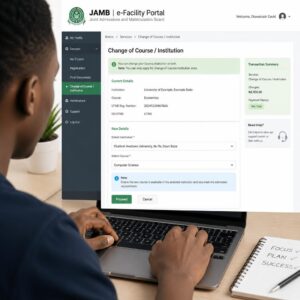
- Verify the uploaded grades. After the upload, log in to your JAMB CAPS profile (via the JAMB e-Facility portal at jamb.gov.ng/efacility) and confirm that your subjects and grades appear correctly. Errors in uploaded grades can affect your admission eligibility.
- Upload to the university portal as well. Many universities require you to separately upload your O’level results to their own admission portals. Check your chosen institution’s admission portal for specific instructions.
Two-Sitting Results
If you are combining results from two examination sittings (for example, WAEC from one year and NECO from another), you will need to upload both sets of results to JAMB CAPS. Most Nigerian universities accept two-sitting O’level results, but some do not. Always verify your chosen institution’s policy on two sittings before relying on this option.
Deadlines You Cannot Afford to Miss
This is where many awaiting-result candidates lose their admission, and it deserves your full attention.
The JAMB CAPS Upload Deadline
JAMB typically sets a deadline by which all candidates must have uploaded their O’level results to CAPS for that admission cycle. This deadline is usually announced on the JAMB website and through official JAMB communication channels. If you do not upload your results before this deadline, JAMB will not process your admission for that session.
The specific deadline changes each year and depends on the academic session. JAMB has, in past sessions, extended the upload window to accommodate delays in WAEC and NECO result releases, but you should never assume an extension will happen.
The University’s Internal Deadline
In addition to JAMB’s deadline, individual universities may set their own deadlines for O’level result uploads. These deadlines can be earlier than JAMB’s deadline and are usually published in the university’s admission guidelines or on its admission portal.
The Practical Reality
WAEC and NECO results sometimes take longer than expected. If your results are released late in the admission cycle, you may have a very narrow window to upload them before deadlines close. This is why you should:
- Monitor WAEC and NECO result announcements actively.
- Check your results immediately they are released.
- Upload to JAMB CAPS within 24 to 48 hours of confirming your results.
- Upload to your university’s portal on the same day if possible.
What Happens If Your Results Don’t Come Out in Time?
If your O’level results are not released before the relevant deadlines, the following outcomes are likely:
- You will not be offered admission for the current academic session. This is the most common outcome. No matter how high your UTME score is, the admission process cannot be completed without verified O’level results.
- Your admission will be deferred to the next session. You will need to reapply in the next admission cycle. Depending on the institution, you may need to re-register for JAMB or simply update your results when they become available. JAMB results are valid for one admission cycle only, so you will likely need to write UTME again.
- You may lose your Post-UTME score. Post-UTME scores are typically valid only for the session in which they were obtained. If your admission is not processed this session, you will need to sit for Post-UTME again next year.
What You Can Do to Reduce This Risk
- Write your O’level exams as early as possible. If you are in SS3, consider writing WAEC or NECO in the earliest available sitting rather than waiting for the last one.
- Consider writing both WAEC and NECO. Having two examination registrations increases the chance that at least one set of results will be released in time.
- Monitor result release announcements closely. Follow the official WAEC and NECO websites and verified news sources for updates.
Institution-Specific Variations: What to Watch For
Nigerian universities are not uniform in their approach to awaiting results. Here are some important variations to be aware of:
| Factor | What Varies Between Institutions |
|---|---|
| Post-UTME eligibility | Some allow awaiting-result candidates to sit for screening; others do not. |
| O’level upload deadline | Each university sets its own internal deadline, which may differ from JAMB’s. |
| Two-sitting acceptance | Most accept two sittings, but a few competitive programmes may require one sitting. |
| Minimum credit requirements | The number and specific subjects required at credit level vary by course and institution. |
| Provisional admission | A few institutions may offer provisional admission; most will not. |
| Direct Entry requirements | Direct Entry candidates may face different O’level timelines and requirements. |
Because of these variations, you must check the specific admission requirements of every university you are considering. Do not assume that a policy at one institution applies to another.
Step-by-Step Guide for Awaiting-Result Candidates
If you are currently awaiting your O’level results and want to maximise your chances of gaining admission this session, follow these steps:
Before Your Results Are Released
- Complete your JAMB registration with “Awaiting Result” selected in the O’level section.
- Write your UTME and aim for the highest score possible.
- Check your chosen universities’ Post-UTME advertisements to confirm whether they accept awaiting-result candidates for screening.
- Register for Post-UTME at institutions that permit it.
- Sit for the Post-UTME screening and perform well.
- Monitor WAEC, NECO, or NABTEB announcements for result release dates.
- Keep your examination number, card PIN, and serial number safe. You will need them for result checking and uploading.
As Soon as Your Results Are Released
- Check your results immediately using the official WAEC, NECO, or NABTEB result-checking portal.
- Confirm that your grades meet the O’level requirements for your chosen course (typically a minimum of five credits, including English Language and Mathematics, in relevant subjects).
- Go to an accredited JAMB CBT centre and upload your results to JAMB CAPS.
- Log in to your JAMB CAPS profile and verify that the uploaded grades are correct.
- Upload your results to your university’s admission portal if required.
- Monitor your JAMB CAPS admission status regularly for any updates.
- Accept your admission on JAMB CAPS promptly if an offer is made.
Common Mistakes and Misconceptions
Mistake 1: Assuming “Awaiting Result” Means Automatic Admission Later
Selecting “Awaiting Result” during JAMB registration is not a promise of future admission. It simply allows your registration to proceed. You must still meet all O’level requirements and upload your results before the deadline.
Mistake 2: Forgetting to Upload Results to JAMB CAPS
Some candidates check their O’level results, see that they have passed, and assume the university will automatically access those results. This is not how the system works. You must actively upload your results to JAMB CAPS. The university cannot process your admission without this step.
Mistake 3: Uploading Results to JAMB but Not to the University Portal
Many universities require a separate O’level upload on their own admission portals. Uploading to JAMB CAPS alone may not be sufficient. Always check both requirements.
Mistake 4: Waiting Too Long After Results Are Released
Delays in uploading can cause you to miss the admission window. Results should be uploaded within days of release, not weeks.
Mistake 5: Assuming All Universities Accept Two Sittings
While most do, some competitive programmes and a few institutions require all five O’level credits in a single sitting. Verify this before relying on a two-sitting combination.
Mistake 6: Ignoring Subject-Specific Requirements
Having five credits is not enough if the specific subjects required for your course are missing. For example, a candidate seeking admission to study Medicine must have credits in English, Mathematics, Physics, Chemistry, and Biology — not just any five subjects.
Misconception: “JAMB Will Hold My Admission Until My Results Come”
JAMB does not hold individual admissions indefinitely. The CAPS system operates within defined timelines for each admission cycle. If your results are not uploaded within those timelines, the system moves on.
Frequently Asked Questions
1. Can I register for JAMB with an awaiting WAEC result?
Yes. JAMB allows you to select “Awaiting Result” during registration. Your UTME will be processed normally. However, you must upload your WAEC results to JAMB CAPS before the admission deadline.
2. Can I write Post-UTME with an awaiting result?
This depends on the university. Many institutions allow awaiting-result candidates to sit for Post-UTME screening, but some do not. Check your chosen university’s official admission guidelines for the current session.
3. Will I be offered admission if my O’level results come out after the Post-UTME but before the JAMB deadline?
Yes, this is possible. As long as your results are uploaded to JAMB CAPS and the university’s portal before the relevant deadlines, the institution can process your admission. The key is timing — upload immediately when results are released.
4. What happens if my O’level results are not out before the JAMB upload deadline?
You will most likely not be offered admission for that academic session. You will need to reapply in the next cycle. This is why writing your O’level exams early and monitoring result announcements closely is critical.
5. Can I use two different O’level results (e.g., WAEC and NECO) for admission?
Most Nigerian universities accept two-sitting O’level results. You will need to upload both sets of results to JAMB CAPS. However, a few institutions and competitive programmes require all credits in one sitting. Always verify the specific policy of your chosen university and course.
6. Do I need to upload my O’level results if I already uploaded them during a previous JAMB registration?
If you are using the same JAMB profile and your results are already on CAPS, they may still be accessible. However, if you have new results or a new JAMB registration, you should upload the current results. Confirm with a JAMB CBT centre if you are unsure.
7. Can Direct Entry candidates apply with awaiting results?
Direct Entry candidates must also meet O’level requirements. While some institutions may allow Direct Entry applicants to begin the process with awaiting results, the O’level results must be uploaded and verified before admission is finalised. Check your chosen institution’s Direct Entry guidelines.
Conclusion
An awaiting O’level result does not disqualify you from beginning the university admission process in Nigeria. JAMB permits awaiting-result registration, and many universities will allow you to sit for Post-UTME screening while your results are pending.
However, the window between “beginning the process” and “receiving an admission offer” is where the real challenge lies. Your O’level results must be released, uploaded to JAMB CAPS, and uploaded to your university’s portal before the applicable deadlines. If this does not happen in time, your admission for that session will not be processed, regardless of your UTME or Post-UTME performance.
Your most important actions right now are:
- Confirm whether your chosen universities accept awaiting-result candidates for Post-UTME.
- Monitor your examination body’s result release announcements daily.
- Prepare your examination details so you can upload immediately when results are out.
- Upload to both JAMB CAPS and your university’s portal without delay.
- Check the official JAMB website and your university’s admission portal regularly for deadline updates.
Do not leave this process to chance. The difference between gaining admission this session and waiting another full year often comes down to how quickly and carefully you handle your O’level result upload.